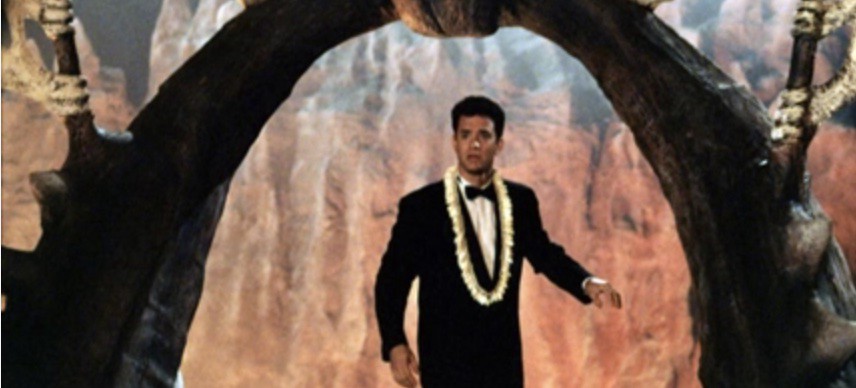
There is a particular film that I love starring Tom Hanks and Meg Ryan from many years back, John Patrick Shanley’s Joe Versus the Volcano. It is a fairy tale and begins, “Once upon a time there was a guy named Joe who had a very lousy job…” With these words we are introduced to Joe who is grinding at his job and struggling with his health. Everything about Joe feels mopey. His hair is unkempt, his clothes a mess. He complains of feeling sick and not knowing why. Joe in his heart seems to understand what his sorrow is, but he is incapable of changing his life until he learns that he has a terminal illness — a brain fog.
This fairy tale story of Joe is relevant to discussing fathers and sons, and where boys and men get stuck in life. Like so many men, it is only when everything is stripped away that Joe is able to see his life more clearly and discover who he is. It is an opportunity for Joe to do something different and make some sense of his life.

While Joe at one time did work that was meaningful to him as a fireman, he chose safety of an office instead of the risk that came with his heroics. Unconsciously though Joe is expressing some of his real feelings. When Dede (Meg Ryan) sees him hunched over his worn and broken shoe, she asks, “Hey Joe, what’s with the shoe?”
This prompts Joe’s absentmindedly spoken truth, “I’m losing my sole.”
The life transition of men can be seen in Joe’s odyssey. Joe doesn’t know himself, and this is in part what our boys and men are struggling with. It explores what happens when you don’t follow what you enjoy doing, and instead resign yourself to a path instead of making life changes.
To me one of the most enjoyable parts of this film is the montage of Joe coming into himself after he is hired to throw himself into the volcano. It is during this montage of Joe preparing for his journey when Marshall (Ossie Davis), the wise limo driver begins the transformation process. Marshall is in effect Joe’s version of a fairy godfather who helps transform Joe for the journey.
What follows is a sequence of Joe shopping, buying new clothes and collecting things for his journey. While some of the things Joe collects seem ridiculous, this is about Joe trying to feel out what he likes, and what defines himself as a person.
An important scene in this sequence is when Joe buys luggage from the “luggage salesman” as played by the Irish stage actor Barry McGovern. The scene is imbued with the significance of going to the Oracle of Delphi. McGovern plays somewhere between a wise man and a trickster who is assisting Joe on his journey.
Finally, to me comes the most important scene. Joe gets his haircut by Cassie played by Carol Kane. Cassie cuts Joe’s hair and says, “You look like a prince in a fairy tale”
This is when Marshall says what I think is perhaps the most important line in the film,
“You’re coming into focus kid.”

This line was an acknowledgement of Joe’s transformation and arrival at adulthood. This is the true moment of Joe’s transformation, just as Cinderella transformed under the wand from the fairy godmother. The transformation though which is seen as outer, is an amplification of what is occurring insideof the hero in these fairy tales. We are good at mistaking these moments as being purely superficial, but they are in fact metaphorical and spiritual moments. Joe is coming into focus. While Marshall tells him earlier that the “clothes make the man” we can see in fact that the clothes amplify that heroic quality that is within Joe.
Most importantly though is that Joe is taken under the wing of a father like figure in Marshall.
HOW CAN WE COME INTO FOCUS AS MEN?
Joe was coming into focus and owning his life, and this is something we all struggle with at various times in our lives. The ups and downs of life present us with challenges, failures, triumphs and losses. Sometimes it presents our fears like Joe’s fear of being a fireman. Sometimes we choose safety and stay too long in a life place that we have outgrown. Men in particular become mired in place like Joe, afraid to reinvent ourselves because we identify with the job that we had for so long, that we cannot see another way forward.
The trope of the midlife crisis occurs at this time because we gravitate again toward the puer aeternus (the eternal boy), when we feel lost. We refuse to cross the threshold into the next part of life.
Of interest to me is not just how this relates to men, but how can we as fathers guide our sons in life around life transition and rites of passage, like Marshall did.
Fathers need to help our sons come into focus, and we need to help create boundaries around the things that will steal their focus. We can help them figure out where the soul-sucking is in their life. Alternately we can help them find what is soul nourishing. We can teach them to find meaning outside of a job and the traditional role of a man who provides from a distance. We can also look back at the past generations in our family and really question whether our fathers were there for us the way we needed. Were their fathers there for them like they needed? How far back was it that men detached and thought to themselves, this is a good thing.
As men we are all struggling with thousands of years of patriarchy that says men should be a certain way. We should be strong and quiet. We should be providers who sacrifice. We sacrifice our time with our family to put bread on the table, however it is a modern dilemma that separates families all day, and the jury is still out whether this is best for any of us. The absence though of fathers I believe, leads to the future absences of our boys being present to their future relationships, their families and also themselves.
In short, men need to be more involved and interested in what their sons are interested in. We need to try and find how to make that connection with our sons and how to be present for the ember of their interests. We need to create boundaries around the things that would steal their soul/sole. We need to question whether staying up all night to play video games or lose time to the latest social media craze, is a good thing.
Is it soul-nourishing or soul-sucking?
And…we need to be aware if those things are happening. Are they staying up all night lost on the internet? Do they get up groggily a couple hours later to sleep during school?
Are we okay with this? Is this what we dads want for our boys?
We as men need to be present instead of fading to the background, and our presence for our sons ensures that their future happiness will be more assured, and their relationships more secure because they will feel more connected and secure with us. We need to acknowledge that we dads are a big part of the equation in the life or our children.
RITES OF PASSAGE & RITUALS
When we watch Joe versus the Volcano what we can pay attention to is something very important. Joe is going through a Rite of Passage, a ritual transition in life with a metaphorical death in this case as he enters into a new phase in life. Part of what makes Joe’s rite of passage so powerful, is that it has big consequences for Joe, but in life there are small rites of passage and big rites of passage. Going to the prom is a rite of passage, getting married is a bigrite of passage, but there are smaller rites that help to define and celebrate life transitions, like when a toddler takes their first steps, or stops wearing a diaper.
HAIRCUT RITUALS
Joseph Campbell mourned the loss of ritual in our culture and human lives, but much of what Campbell was mourning was the move from religion to secular life. What Campbell implied in books like The Power of Myth, and the Hero with a Thousand Faces, was that to move away from religion meant that ritual had been lost. However, Campbell had trouble acknowledging the way ritual and rites of passage still exist in a myriad of ways in our world. The question is whether we acknowledge the rites of passage and the transitions in our lives, not whether they exist.
The idea is that as we move away from ritual, we move away from perceived meaning in life, and a lack of meaning opens the door to people needing to find a path for themselves, they find their own rituals. Unconsciously people may also seek to suppress the pain that comes when they feel that their life lacks meaning. These become self-destructive rituals.
We as humans need meaning, which often translates into having life goals, passions, interests, and hope. However, much in our world today seems designed to strip us of our interests, undermine our goals, and smother the ember of passion before it even catches and creates heat.
Has the lack of meaning in life, been replaced with a series of dopamine hits that come from drug addiction, video game addiction, phone addiction and porn? How can teen boys in particular navigate the world where the quick dopamine hits offered, undermine a sense of self and self-motivation?
Teen boys are exposed to a barrage of dopamine hits, that quickly overpower the sense of self-discovery that comes from engaging in the world.
SECULAR RITUALS vs LOST BOYS
Not all rituals have to be big planned things, and often they happen because we are moving unconsciously toward something. My youngest son had a secular ritual a few weeks past. He has just reached that age of 13. That age when boys are in danger of slipping and becoming lost boys, a term I borrow from Peter Pan and the band of lost boys who live on an island and never grow up. The term also implies though that to join the band of lost boys means the boys are lost to us as parents, or even lost to the world.
In this small ritual I was doing first spring cleaning of our yard, I had just readied the tractor mower. That’s when my youngest asked me if he could cut the lawn. Yes, I said, it’s time. I gave him a quick lesson on our John Deere tractor mower, and he climbed up and began his first excursion driving around our large property and cutting the lawn. This is an important transitional moment for my son, and one that could easily be missed for the ritual and the importance that it carried. My son was given the keys and given the chance to drive a mower like an adult. He was able to contribute. He was empowered even if in a small way, although I don’t believe this was that small a thing. Perhaps it is a very American ritual, to pass the torch to our sons and have them mow the lawn for the first time. My son in that moment was empowered, and importantly he felt my trust.
Joseph Campbell acknowledged that even for him as a child, there was a transition when he moved from wearing, “short trousers…knee pants” to long pants. Again, Campbell lamented about these “modern times” saying, “Boys now don’t get that. I see even five-year-olds walking around with long trousers. When are they going to know that they’re now men and must put childish things aside?” Campbell was talking about a small ritual, to mark when boys become men.
It was Arnold Van Gennep in The Rites of Passage, who also wrote about life transitions. In one section he even wrote about one seemingly small ritual, the haircut as a rite of passage:
The sacrifice of the hair includes two distinct operations: cutting the hair, and dedicating, consecrating, or sacrificing it. To cut the hair is to separate oneself from the previous world; to dedicate the hair is to bind oneself to the sacred world and more particularly to a deity or a spirit with whom kinship is in this way established.
Van Gennep said, “To cut the hair is to separate oneself from the previous world.” The hair cut to Van Gennep marked a transitional time, from childhood to adulthood and marked this transition as if through consecration. There is ritual without religious significance although arguably there is unconscious mythological significance. The significance comes up from the unconscious but more than that, when the appearance of someone changes, from let’s say the boyish haircut of youth, to their first adult haircut, it underscores that transition, and an owning of one’s Self.
This is what we are unconsciously drawn to in Joe versus the Volcano. When Joe gets his haircut, we feel that separation from the previous world, and his entering into adulthood. We also perhaps unconsciously feel it as a consecration, which means making something sacred.

The haircut is the ritual act that marks when the boy becomes the man, and as Marshall said, it brings him into focus. My son also decided just before turning thirteen that he no longer wanted me to cut his hair, because I “made him look like a kid” he said. He went to a hairdresser for the first time. For me it was important to honor my son’s wishes and internally make space for his need to separate himself from that previous world, where a child gets child haircuts from his dad.
Recognizing where our sons become more independent and giving them room to grow and engage with them more as adults is important and is a transition for us as dads too.
WHERE TO FIND RITUALS?
In terms of rituals, I am not suggesting people must bring religion into their lives. I am suggesting ways to consider what ritual can be added, and where can we honor a ritual, that transitional rite of passage. Religion does offer rites of passage, but my suggestion here is to figure out how to make something personal if it is part of a bigger group ritual that feels impersonal to the individual boy.
SMALLER RITUALS
I’m not going to delve into suggesting what alternative bigger rituals are, I’m hoping that some may filter up from the unconscious for dads who may read this. I want to end with just talking about smaller rituals and keeping dads in the fold with their sons. What rituals can we do to stay present with our sons, because our time with them in essence is short and they will soon be grown up and out on their own. The seeds we plant now, the relationships we build when they are young, are the things they carry with them out into the world.
Some smaller simpler rituals can be Sunday breakfast with dad, a bedtime story or watching a show together each week. Each family is unique though and finding a ritual that fits is important. What rituals can you create together? Do you climb up on the roof and look at the stars at night? Do you watch AGT once a week? Do you have family dinners with no cell phones allowed? Are you a bookish family that reads something together at dinner? Start with the small rituals and try to think of how some of these things are consecrations. How does reading a bedtime story make bedtime a sacred and safe time before the lights go out? How do our boys carry that safety with them in their life?
Then see if you can become aware of where those transitional rituals are. Find the ritual of doing something for the first time, or doing something for the last time, like when toddlers stop wearing diapers or boys get their first haircut. Can you acknowledge it to them and to yourself when these things happen?
Maybe you’ll feel the transition approach when your son starts school for the first time, and you take him to a luggage store for his first school backpack. If you’re lucky someone like Barry McGovern will help find the perfect backpack as a “luggage problem” and help usher your boy into this next phase of life. Each small act like this is a chance to find a way to mark something as important, and plant seeds into the future for our boys.

 Follow Your Myth