There is a particular children’s book that I read to my sons when they were little, that still resonates with me now that my oldest is grown, and my youngest is nearly grown up.
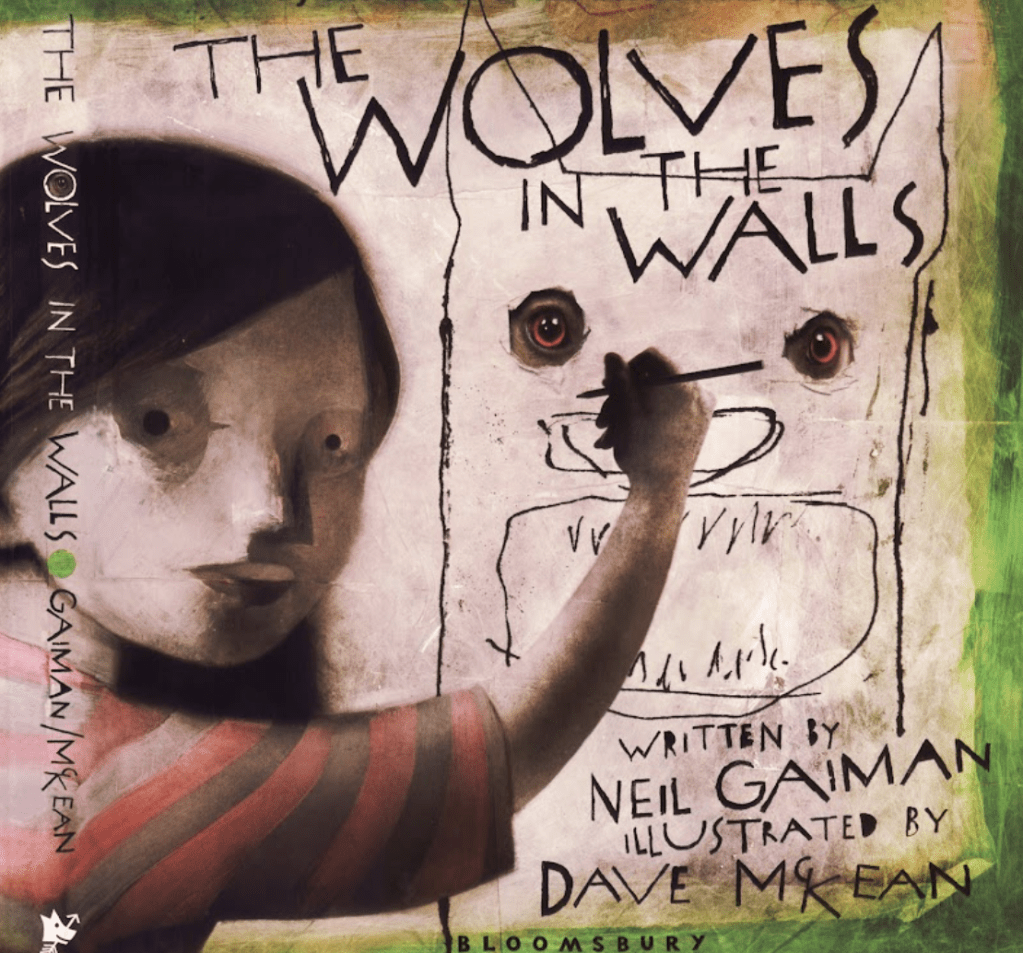
Wolves in the Walls, by Neil Gaiman and illustrated by Dave McKean may fall under the umbrella of what I might call a dark fairytale. It isn’t just the writing that could be somewhat dark and scary to children, the illustration style is also somewhat darker, with faces of characters by Dave McKean that almost resemble wooden puppets or marionettes.
I want to look at why a fairy tale story like Wolves in the Walls may not just be a good book for children today but how it may be a metaphorical look at things we adults carry inside of us as well.
Keep in mind I say it may be a good book for children because every child reacts differently to a children’s book, some may in fact be scared by this book or simply not interested in it.
METAPHOR OF THE WOLVES
The wolves in this book can represent many things. We are free to project onto these wolves, and I myself have been in a weird frame of mind lately where I have had trouble sleeping, and thus late at night, I have heard the coyotes scrabbling down the creek here in Colorado, just behind the studio barn my wife and I share.
There was a sleepless night recently where at 3 in the morning I found myself downstairs, and I heard what sounded closer to a wolf behind my studio howling at the full moon. It was a somewhat scarier sound than I am used to in Colorado and my concerned cat came to the window to listen with me. We gazed out together wondering about the beastie on the other side of the barn.
The wolf I heard that night, and the wolves I sometimes write about metaphorically reminded me of Wolves in the Walls. In particular the line from the book that is repeated;
“If the wolves come out of the walls… it’s all over.” Let’s take a look at the story and discuss what it might mean when the wolves come out of the walls.

THE STORY
Wolves in the Walls follows Lucy a young girl who lives with her brother, mother and father. Her family is busy doing the things a family will do. Each person has their own particular hobby, but Lucy hears noises in the walls of the house.
She is preoccupied by it.

Lucy seems to know exactly what makes these noises in the walls. She comes to the conclusion that there are wolves in the walls of the house, and she tries to warn her mom, who doesn’t listen.
The sounds continue to get louder and Lucy warns her dad, but he again repeats the same phrase that mom says;
“If the wolves come out of the walls, it’s all over.”
For the third time, Lucy warns her brother who again dismisses her fears, and repeats the dire warning should the wolves come out of the walls.
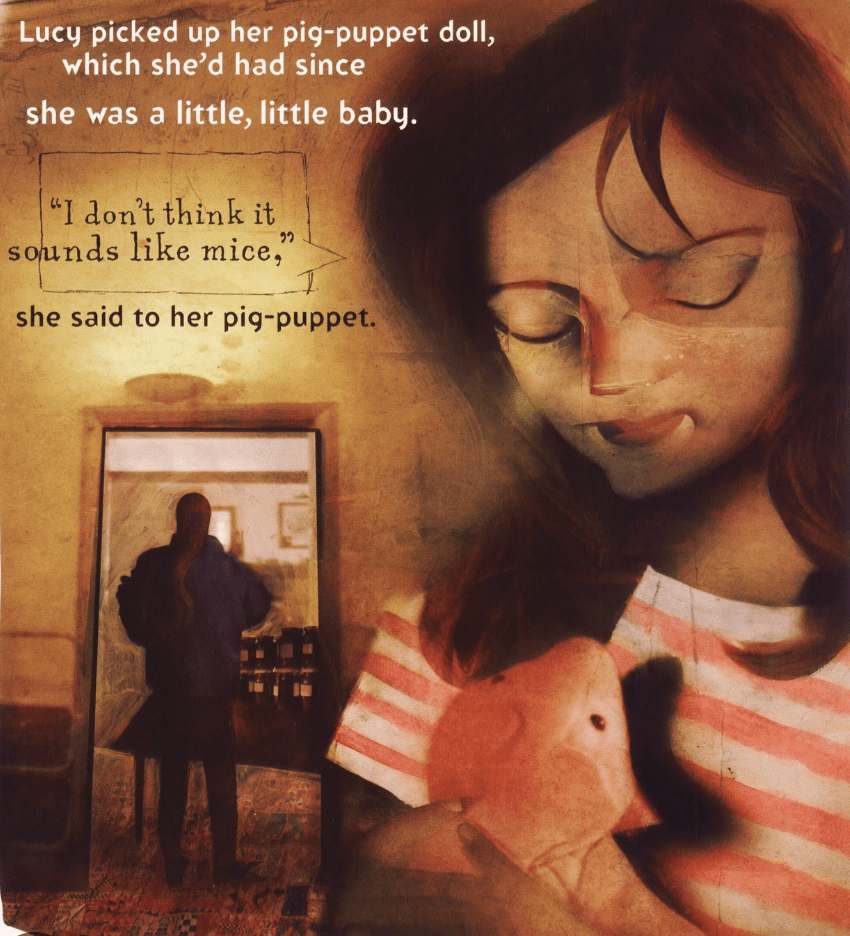
On the fourth night, the wolves do indeed come out of the walls and take over the house. The family runs to the garden and lives near the shed not daring to go back, except that is for Lucy, who left her pig puppet in the house.
Her parents tell her they will buy a new pig puppet for her, which she rejects. So Lucy creeps back up to the house and slips into the walls of the house.
WHAT DOES IT ALL MEAN?
To a young child reading this book, this is simple, it’s about danger and the heroics of Lucy who takes back the house from the wolves. To very small children the pig puppet itself may represent a smaller helpless child – or at the very least a stand-in for their own special stuffed animal. They will side with Lucy when she goes back to rescue her pig puppet.
We can look for clues to what other things the story may represent.
Perhaps it represents Lucy’s own anxiety and fear and the way she overcomes it, by going through it. She does this by slipping into the walls of the house – the space that had been occupied by the wolves.
It was a place occupied by her monsters.
A good fairytale seems to have solid creatures like the wolves. It has monsters and heroes but all the while it is a metaphor. The story may at some point feel real and scary to a kid, but in the end, children may feel the satisfaction with the resolution, and this becomes part of them, as a fairytale should.
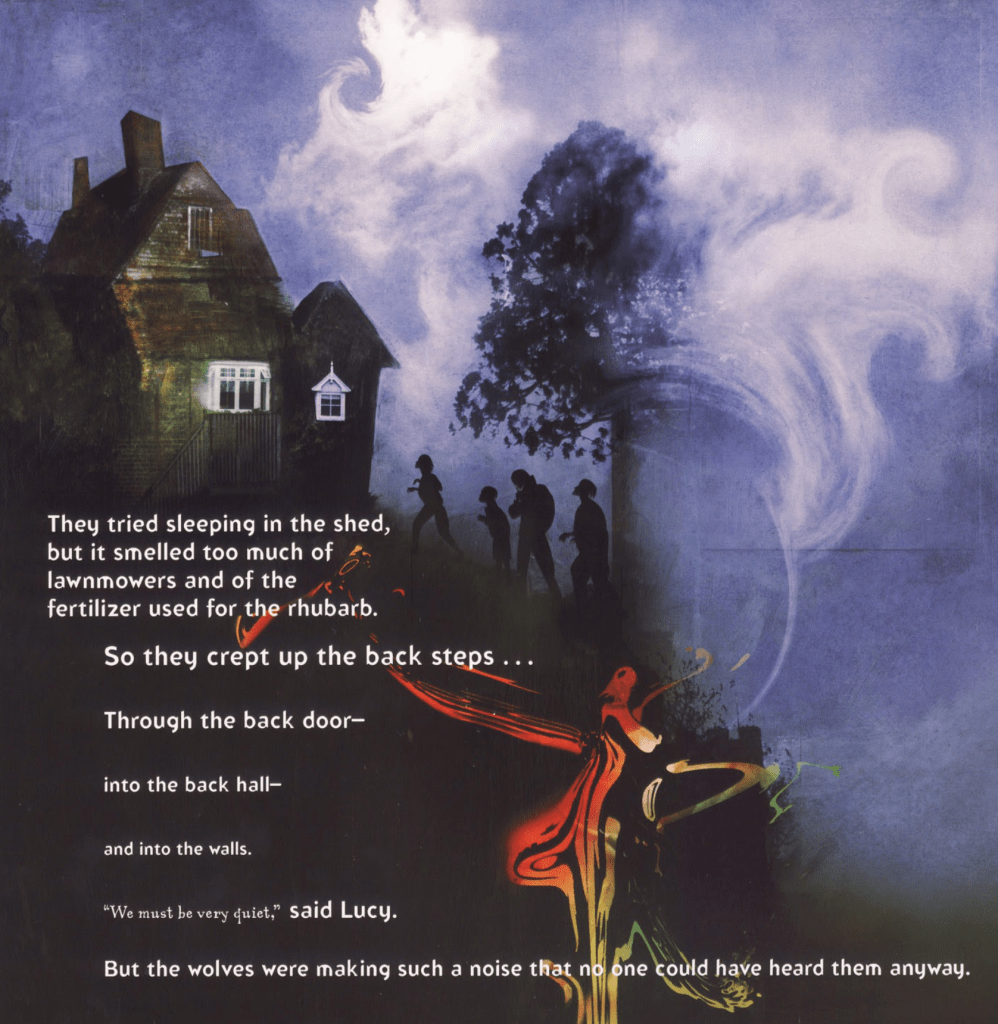
The wolves represent whatever wolves may mean to you, and this may change over time. Bruno Bettelheim wrote about how the symbolism and meaning derived from the fairytale are different throughout a child’s life. I would argue that even into adulthood our internal sense of meaning around fairytale stories is adjusting and evolving throughout our lives.
In this case, we are told repeatedly that when the wolves come out of the walls, it’s all over. This refrain we could look at as being something that this family, in particular, carries with them. Perhaps, it is some multi-generational trauma that seems to stalk their family like a pack of wolves in the night.
As a fairytale though it suggests universal themes, which to me suggests something along the lines of trauma and even depression or anxiety that are the result of some trauma.
I am not saying that Gaiman was thinking this consciously when he wrote it.
It could be that Gaiman’s own familiar family experience informed his writing on a personal level. However, it is also his ability to tap into unconscious imagery that allows for a story to take on universal themes that make this and other stories by Gaiman resonate with audiences.
Personally, I use the following phrase to describe when I feel depression coming on;
“The wolves of depression are nipping at my heels.”
I didn’t get this phrase from anywhere in particular, it came up from my unconscious and came back to me the night that I heard what sounded like a wolf beyond the barn. This made me think about writing an essay about Wolves in the Walls, because for me the wolves may represent trauma and depression.
A wolf or coyote howling harkens back to something primeval, and even though I did not grow up hearing coyotes, I can feel something stir in me that suggests danger. This may be ingrained in us from ancient times, part of our collective unconscious and a connection to our ancestors in ways that are hard to explain completely.
THE TAKEAWAY: GOING INTO THE WALLS
The takeaway for me for this fairytale comes when Lucy is determined to go back to the house and take it back from the wolves. She does this by sneaking into the walls of the house.
She has become the thing in the walls, and after her first mission to save her pig puppet, she convinces the entire family to go into the walls and take back the house.
In essence, Lucy has embraced the trauma, the depression, or anxiety, and instead of avoiding it or denying it, she goes within. She confronts it.
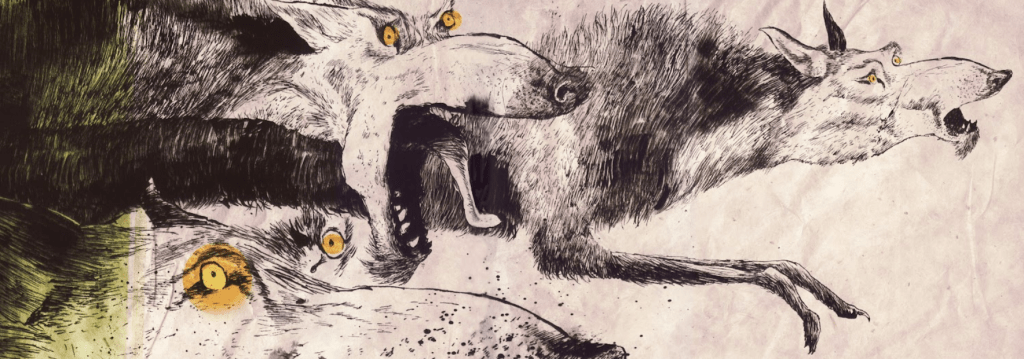
The family together decides to confront these wolves and protect the home… the life they built together.
It is a descent into the maze as surely as Theseus ventured into the maze to kill the Minotaur. Just as Luke Skywalker descended into the cave to fight an apparition of Darth Vader which had his own face.
Here we have Lucy, who slips into the walls of the house to do battle with the wolves.
A MODERN FAIRYTALE
Neil Gaiman appears to write and access that place of the unconscious often in his writing. He accesses our collective dreamscape, the unconscious landscape. Gaiman doesn’t necessarily try to interpret the meaning for his readers. He also does not try to soften the story as so many picture books may do.
Instead, Neil Gaiman wrote this story in a way that gets back to older fairytales, and although hardcore folklorists and fairytale experts may insist this is not a fairytale at all, I believe it qualifies as a fairytale under a broader definition of what fairytales are.
I believe that Neil Gaiman is one such writer who carries the torch of writing fairytales – passed down through countless generations. He carries that torch into the dark dreamscapes, lighting up small bits for us in these shared mazes we stumble through.
 Follow Your Myth