An audio version of this article is below, if you would like to listen instead.
A little over a year ago I wrote about grief and the intertwining of words, talking of May Sarton’s explanation that the gothic word Kara, means “lament” and is the root word for care.
This intertwining of words means that lament, or rather grief, is built into the word care underscoring that we as humans live in more than one place at the same time.
In other words, loss may be present, even in a joyful moment.
We are animals that live in the present as well as the future as we make plans for our lives. However, there is an intertwining of future loss that allows us to feel the nature of each moment as being fleeting, each moment as impermanent.
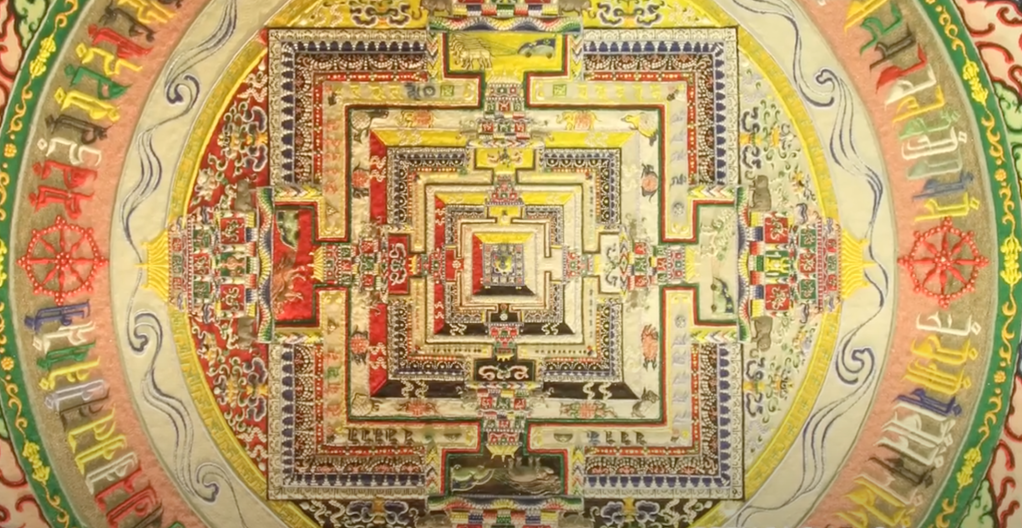
This video below, expresses some of what I am talking about. The Buddhist monks created the sand mandala, which embodies the life lesson of impermanence, as well as human suffering. At the end of weeks of creating, they destroy the mandala with a hand stroke (not seen in this video).
As we get older, we may find ourselves re-evaluating our lives and weighing the past again. This experience means we may find ourselves at a crossroads of thinking about the future, as we evaluate our past mistakes, conduct, values, and life choices.
FLASHBACKS & UNRELIABLE NARRATORS
In literature, film, and television, writers use the phenomenon of folding with our past in the form of flashbacks. The flashbacks inform us of what the characters have gone through, what they may be carrying, and what influences their life.
Even though we may see these flashbacks we also have to keep in mind that there may be an unreliable narrator. This unreliable narrator has an idea or memory that may not be accurate. This is because we invoke meaning to our memories that depends on where we view them from. We color our narrative, with our projections about how we may be perceived, and how we perceive ourselves. We may start to color our narrative with things like, “life is unfair” or “you can’t trust people.”
We all have an unreliable narrator in some respect.
This unreliable narrator may paint the picture of our past in a certain light. Perhaps we felt bullied when we were kids but looking back from midlife, we may make peace with our experience by working with how it affects us in our daily life. These kinds of experiences may have been fleeting but take up far more space effecting our daily life. They may have affected our self-esteem, and our perception of who we are.
This next video example is not to say that our experiences are in our mind but there is a funny example of a comically unreliable narrator from the series 30 Rock.
In this episode that centers around a high school reunion, we learn that Liz Lemon’s character (Tina Fey) was the actual bully in high school. During this sequence, her boss and friend Jack (Alec Baldwin), also finds a connection to a past he never had. In the clip below we are seeing this scene play out for a second time, with the first version in Liz Lemon’s head representing her being bullied. In this clip it is the other way around, she uses her acerbic wit to destroy the popular girl’s self-esteem.
This is a comical representation of how someone has a very inaccurate narrative of their past. What is accurate though is the way she has carried that story and believed it was real and that she was not liked.
FOLDING WITH OUR LIFE
I have mentioned the term folding in this article above and it’s time to explain this idea of folding.
When I am talking about folding, I am usually talking about the act of folding to a point in time in our minds and allowing ourselves to be present in that moment, to examine it, to consider it.
I may also be talking about folding with an emotion, or a thought. It could be an emotion we are experiencing in a moment, like rejection. It may be a thought or even a single word such as trust.
Folding can be an active process that is amplified through journaling or meditation. What I’m describing is an active process of contemplation or meditation in such a way as to consider those wounded or triggered parts of ourselves – and to hold that, to stay with it, even when it becomes uncomfortable.
We become present for that moment in time, that important experience that creates part of our life tapestry which I talk more about in this article, Mural of Souls;
I try to teach people to fold with these moments of conflict or triggers in our lives so that we may find some insight. I believe that this mental exercise is part of what happens in psychotherapy. We fold and hold uncomfortable things to find healing, growth, and insight. We are in effect re-wiring the brain.
FOLDING WITH THE PAST
As I get older, I have taken to the idea that we fold more and more with our lives as we age. We look to the past, and we recall significant memories that may have been important to us. We can imagine the texture, the weather, or the time of day at a significant life event, like a funeral, a birth, a wedding, or a schoolyard scrap.
Intentional folding is a way of looking at our lives and trying to understand that tapestry of our story, the narrative of our life, and identify places we may become stuck or lost.
Socrates said, “The unexamined life is not worth living.”
This is something psychotherapists take to heart. We examine lives alongside clients and seek to understand that narrative. We fold in our minds with your past, and reflect that back to you, to help bring some insight – and to allow for you to create your own ability to fold with the past.
You may learn to be present with some harder parts of yourself, or some more painful memories. You may be able to process the narrative you tell yourself, and overcome the areas you are stuck, removing those threads from the tapestry of your life narrative. With time comes understanding and integration as you process parts of your life.
FOLDING WITH THE FUTURE
In the article I linked to at the top of this article, I talked about Plato using the word Anamnesis, writing;
Plato used the word Anamnesis to express a knowing of information, but this Greek word means, “a calling to mind” and does not capture what I’m trying to express which is more about a feeling as if projected from our future mind.
I then examine more words and alter Plato’s word, combining prolepsis and anamnesis to create proemnesis which I define as;
Proemnesis: The experience of recalling something from a projected future emotional or mental state.
In my article, I suggest that we can also fold with the future. I then give an example of an experience I had where I projected my mind into the future (or rather became aware I had been doing that).
Even though I was with my son who was 3, I could see myself looking back from the future when he was 18 and going off to college. That future was present with me – and like the word care/kara, it felt like these moments in space and time were intertwined. In that moment of being present with my son – I felt the presence of future loss – I could feel myself peering back through time at this moment.
It felt as though I could fold with this moment in time, from both sides of that moment.
Why might this experience be important? I am trying to bring awareness to this way that humans live, not merely in the present but intertwined with our past experiences that create our narrative. Likewise, we project ourselves into the future and lament, even at the most beautiful experiences like a birth, a wedding, or simply being with our child at the park or as in my case at an airplane museum. That moment would also become intertwined with his future as now years later he is studying aerospace engineering, with the goal of becoming a Naval aviator.
Perhaps for him the kernel of that future was present as well.
By folding with the future in this purposeful way we get a glimpse of life in the future, which may help us to stay attuned and present for those fleeting moments as they are unfolding. Being with our children in the moment, and being present for our families becomes more important – because we allow for that fleeting nature of our interactions to sometimes, come into the room and remind us that these moments are indeed fleeting and impermanent – even as they are joyful and beautiful.
 Follow Your Myth