An audio version of this article is below, if you would like to listen instead.
Although I am more familiar with western mythology and fairy tales than I am with eastern myth and fairy tales, today I would like to delve a little into eastern mythology – and this article may sound more personal in tone.
My interest in eastern art and myth began as a student in art school when studying art history. This included looking at different cultures, and ancient as well as prehistoric art.
I wanted to understand the thread of why we create, and where it all began.
One image above all from eastern art has always stood out to me more than others. It has been an image I have returned to in my lifetime – and the subject of this article.
I want to examine the Hindu image of Shiva.
LORD OF THE DANCE
It was the mid 1990s and I stood before a mirror in my small apartment not far from the Pacific Ocean. The smell of salt air and the sound of the beach drifted in. The intermittent sound of jets taking off at LAX reminded me of the busy city outside that was already bustling.
I was once again alone in my life, starting over far away from where I grew up on an opposite shore. On the east coast I grew up less than a mile to the bay where I would walk to the beach, and look out at the New York skyline.
Now in Los Angeles part of my daily ritual was to wake with a particular meditation song before starting my day. I would just try to breathe and take my first steps which felt heavy, grief was present again – perhaps it had never left me.
This was the first part of my daily ritual, I wasn’t sure which direction my life was going, but I was setting an intention to face it as best I could – even as I was feeling untethered, weighed down by something that had been welling up in me that I didn’t understand, but needed to understand.
Each day I was offered a choice in my reflection. I knew at least that I had to acknowledge that I had a choice.
Leaning forward to shave in the mirror, my pendant would roll forward like a pendulum from my neck. I had recently adopted this pendant, drawn to what it represented. Partly remembered memories fought their way to the surface from my time in art school. The dancing pendant swung forward getting my sleepy attention.
It was a half-dollar size brass pendant that depicted Shiva the Hindu “great God” the “supreme being.”
This was not a static image of Shiva. This is Shiva as Nataraja – Lord of the Dance, an image I had first seen when studying Asian art with the late Dr. Carl Lunde when I left art school now 8 or 9 years earlier.

I could hear my art history professor’s voice lecturing in my head, “Do you see that Shiva is balanced on one foot? He is balanced between creation and destruction. Do you see?” He would come flying down the aisle and pull off his glasses to make a point, to see if we could see what he was trying to show us.
In those moments I felt like I could almost see it. In the dark of the lecture hall I saw Shiva, and imagined I was seeing him slowly dance, with the universe swirling just through the ring of fire. He seemed to be on the edge of the universe, poised on infinity.
In my little apartment years later, I shave and set my intention in the morning. Shiva as Nataraja accompanies me in those moments, just take the first step. Acknowledge that you too are Shiva, balanced on one foot between creation and destruction, then choose.
I make a choice each morning.
It isn’t a random choice that one might pull from a Tarot deck. It is presented before me. Is it yes or no?
Is it create or destroy?
I try to see my choice – and try to see myself there poised in that delicate balance like Shiva, poised in the eternal dance of the Universe, in the act between Creation and Destruction or rather Annihilation.
When I imagine Shiva as Nataraja in my mind, I always imagine that the Universe is before Shiva, a starry field he faces forward to, but behind him, there is a void like a black hole. I don’t remember this being explained to me, it was more of a feeling I took from this balancing act. It wasn’t that one choice in life could annihilate one and push them into that black hole, yet somehow, I sensed that to make many choices repeatedly, may consign one into that black hole, the abyss of self-annihilationwhere there was simply nothingness.
I set my intention and commit. Tomorrow Shiva will ask again.
THE ARCHETYPE OF SHIVA NATARAJA
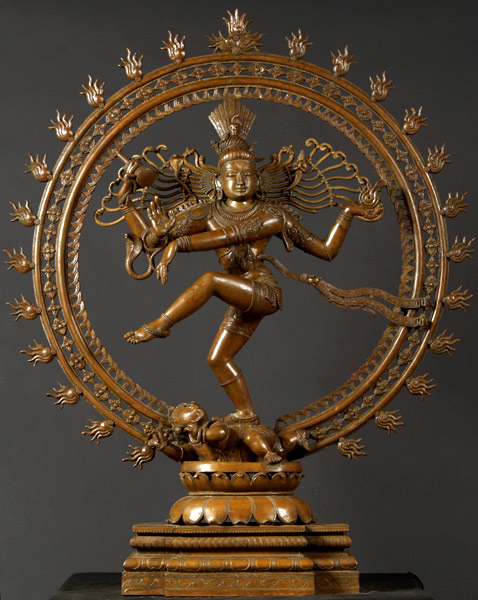
Shiva Nataraja dances in a circle, the outer edge in flames. He is raised up on one foot – balanced in this dance of creation and destruction.
The four hands of Shiva communicate different things to us.
The small drum in his raised right hand indicates creation of the Universe.
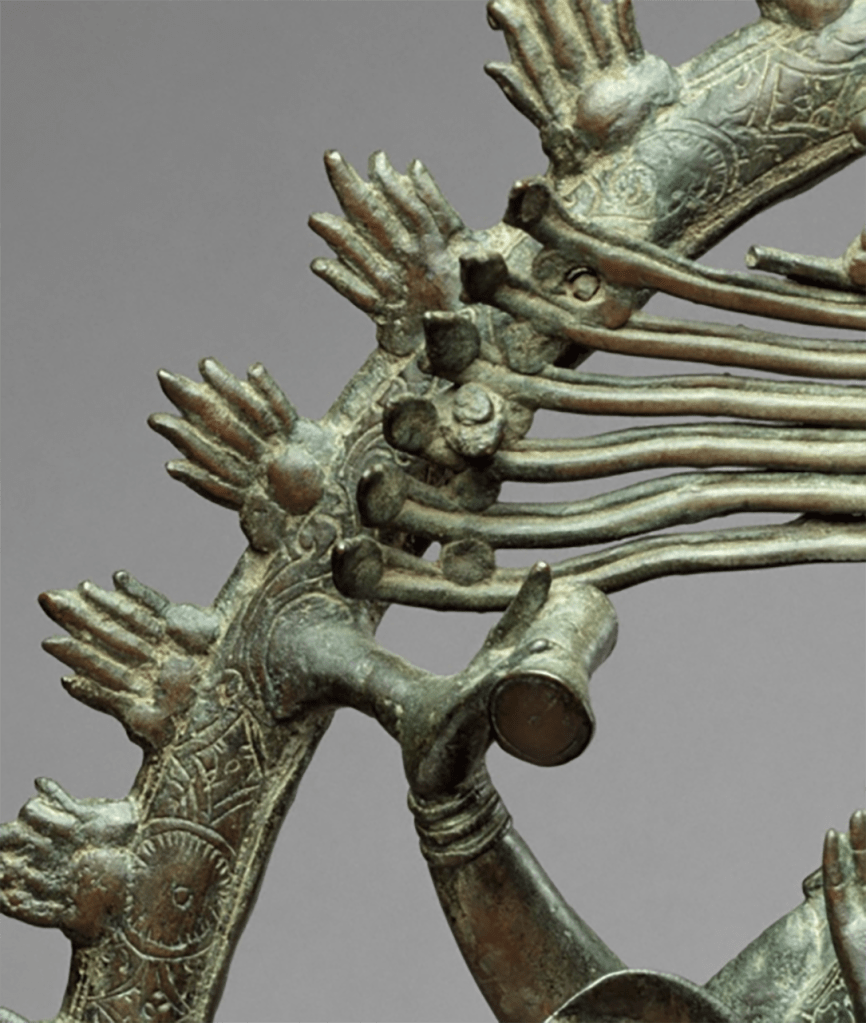
Opposite to this is the flame in the upper left hand indicating destruction or annihilation.

We can see this as a reminder of our nature and the nature of this Universe we are part of. Every moment is a choice between creation or destruction. I shave and meditate on this symbol. I acknowledge the choice, but I remember this all feels familiar, where had I seen this before art school?
I remember at 16 years old I cut a round disk from illustration board. I began a cosmic painting. I still have a photo of the now long gone painting I created. I have no idea what made me paint it. It was perhaps 1982, and there was no internet, and libraries were distant things not easily gotten to. My painting depicts a man who appears to be somewhat transparent, rising from the ocean.
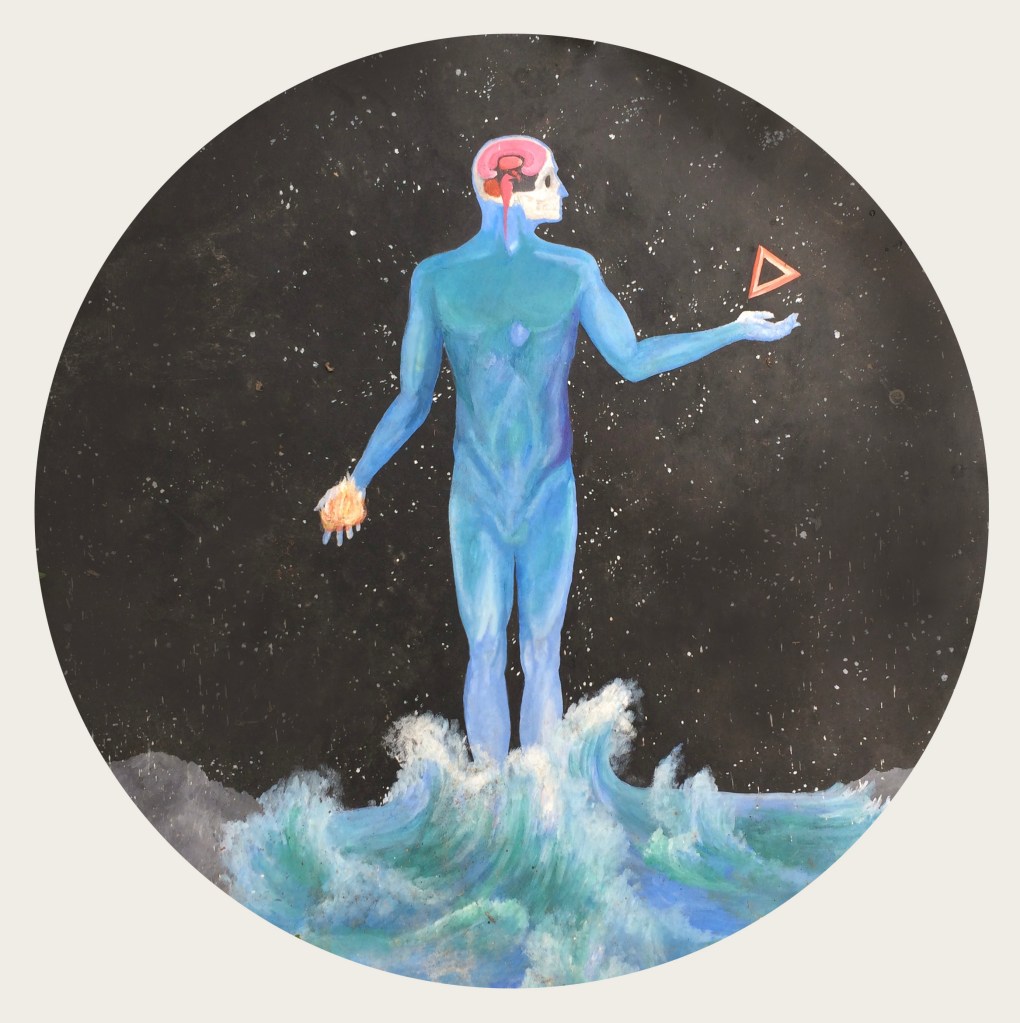
You can see this man’s brain, I was trying to show consciousness I believe. Like Shiva he is in a circle, and like Shiva he has one hand raised in creation showing this twisted triangle. The other hand holds a flame, indicating… I’m not sure, I was 16 and the years have flown. I believe that I was showing the evolution of man’s earliest accomplishment – fire, but it is visually so close to the image of Shiva who holds a drum in one hand, and a flame in the other.
At 16 I had tapped into that archetypal image of Shiva I believe. I connected to what Jung refers to as the collective unconscious, that vast reservoir of shared primordial images we have.
I was attempting to depict the rise of consciousness even if that would not have been the word I would have used at that time. It was the sort of existential things that were beginning to be on my mind at that age though. I was wrestling with what it means to be human, to exist.
This is similar to what Shiva represents to us. Shiva represents the wrestling that we do to make conscious choices, to crush our ignorance as represented by the demon under foot.
The demon who would bring us down.
THE DEMON OF IGNORANCE
I’m an artist and Depth psychotherapist, so I am talking in metaphor, and yet in metaphor we may be able to feel underlying truth to this imagery, and the truth about the nature of the universe.
Like Shiva, we are in a dance with the Universe poised on one foot, we barely acknowledge that infinity is before us, and annihilation behind us. We don’t acknowledge the dance we are in, and that we hold in one hand the ability to create, or the ability to annihilate ourselves and even others.
Underfoot is the demon of ignorance. Writer philosopher Aldous Huxley refers to this as our Ego. The implication is that the ignorance is our ego which becomes attached. I am not saying that we should not be attached to life and living. I am suggesting that the ego becomes attached to our narrative, to the way we perceive ourselves, and the way we think others perceive us. If for instance we perceive ourselves as unlovable, or undeserving.

Shiva Nataraja implies that we must wrestle with our ego. Although Huxley may describe it as breaking the back of the ego, we may see it as balancing on the ego and overcoming the ego impulses that keep us in an internal loop that becomes self-destructive.
The ego, underfoot in our dance remains, we must acknowledge it, and be aware of our precarious dance here at the edge of the Universe. We are in this dance as our higher Self, the complete self which from a Depth psychology perspective acknowledges we are bigger than our Ego (which is a Freudian term Depth psychology prefers conscious self), with a vast unconscious self at work, and even a connection to something far bigger, the collective unconscious.
In this image of Shiva Nataraja we can feel that our consciousness is bigger than what we perceive as our conscious ego self.
Inscribed at the Temple of Apollo were the words associated with the Oracle of Delphi, “know thyself” but perhaps in this case “know thy demon” would be another reflective thought to drive us deeper into knowing ourselves.
What is that thing that you wrestle with? Do you even know you are wrestling?
Can you see it?
The Demon of Ignorance may represent those things that try to throw us off daily in our lives. It is stress, conflict, trauma, pain or loss. It may be an early attachment break that still haunts us. It may have been physical, mental or even sexual abuse. It may be grief and trauma that has not been processed, as it was for me gazing into that mirror all those years ago – and I would have so much more wrestling to do with this. Even now at 58 I am still wrestling with it, balanced on the back of my demon.
These are spiritual issues, and psychological issues, and perhaps issues of universal consequence. When we despair in this life, and are poised in the dance of Shiva, balanced on one foot, we have an opportunity to see our despair and what may be underfoot, wrestling to come up. In those moments, if we can detach from our ego/conscious narrative of what we are fused with, then we can ask the question. How am I like Shiva Nataraja, balanced on one foot? What is my demon?
Do I wish to know it, or will I choose self-annihilation?
WE ARE ALL SHIVA
In adopting Shiva as my symbol, I was acknowledging the universal truth found in the symbolism of Shiva.
I didn’t have this image beaten into my head as something to believe in, it spoke to a psychological and spiritual truth about the nature of the world, and the nature of how we find our way in this world. I was raised Catholic, and had many symbols offered to me before this, but Shiva spoke more deeply and continues to speak to me with the many messages and layers to this symbol.
We are all in the dance of the universe like Shiva each day, and each day we make a choice. Do we choose to be the creator, or the annihilator of our lives? Do we choose to annihilate those around us?
This may seem to most people like an obvious choice, but is it?
How often do people find their way with a glass of alcohol, or a toke of weed? We steady our nerves, suppress the anxiety, or relieve the critical ruminating voices that come from even low-level depression. When the voices or the anxiety go up in volume we crush them with another glass, or stronger weed… or perhaps something stronger from the medicine cabinet. We don’t stay with the anxiety or the ruminating voices because this feels like torture perhaps, but these unconscious voices wish to be heard – and when we suppress them, shove them down, they get stronger, and take more to suppress.
Eventually we may vibrate so hard internally wishing to be heard, that it may come out as panic attacks, anxiety or deep depression.
There are other ways to embrace the annihilator in our lives though, too many ways perhaps, and they don’t all involve alcohol or drugs.
Alcohol seems to be one way to suppress the feelings that well up from inside. I speak of it because having worked with this community since 2020 I have seen how it can swallow whole families.
When people become consumed with alcohol then the truth of their Shiva dance becomes self-evident. They begin to teeter in their dance, the demon at their feet wriggling, taunting, and throwing us off balance.
HAND MUDRA AND FOLDING WITH THE UNIVERSE
We must keep in mind that Shiva dances on two legs with one foot on the demon, one foot upraised in dance, and Shiva has four arms. As I’ve said one hand holding the drum indicates creation of the universe, the opposite hand holds a flame which represents destruction.
However, even an empty hand has meaning, an empty hand may communicate something specifically, and is referred to as a mudra, hand symbols. The second right hand of Shiva is seemingly empty, the arm is wrapped by a deadly cobra. The hand though communicates in its upraised position, “have no fear.”

Important Buddhist sculptures use mudras as well, we can observe the Buddha who found enlightenment under a Bodhi tree. He sits in meditation, with one hand reaching down to touch the ground, “calling the Earth to bear witness.”

Finally, for Shiva Nataraja, the second left hand extends across the body and points downward as if pointing toward the raised foot, it has some of that “calling the Earth” feel to it.
Now instead of going to Hindu explanations of what this may mean, I want to deviate and stay with my own interpretation of this final part of the pose. I want to acknowledge this is not an exhaustive explanation of Shiva Nataraja though, there are other symbols present in the ring of fire, the water, the hair and more, that I am not going to write about today.
My own interpretation of this dancing is trying to understand an unconscious feel I receive from this figure and staying with it. Shiva, with the left arm swept across the body pointing down at the raised left leg is very important to this feeling of the dance of creation and destruction.
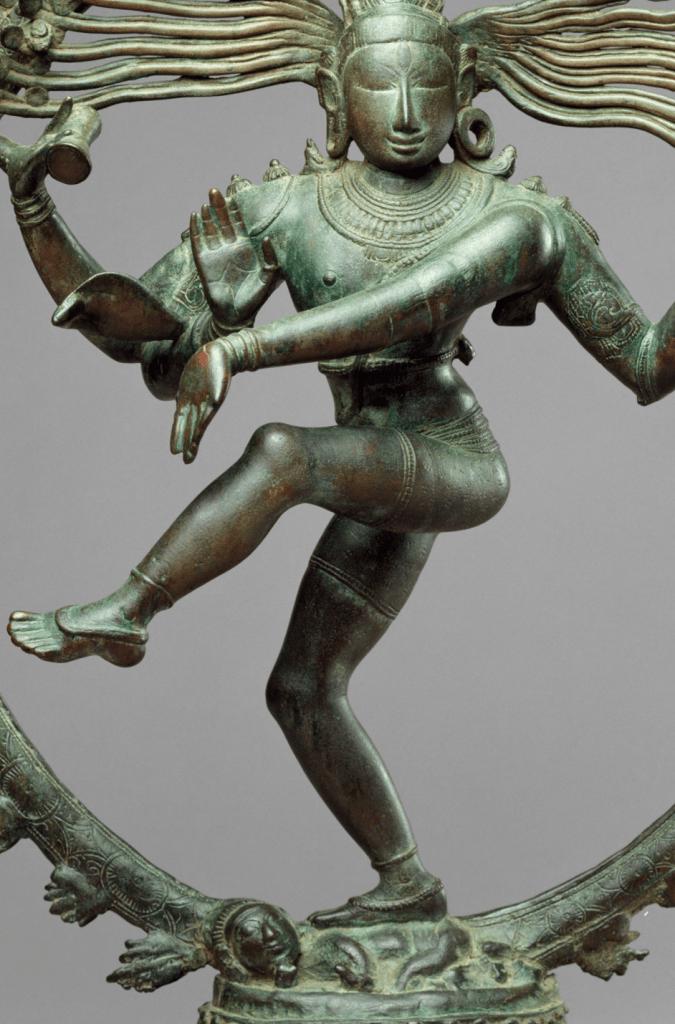
When I see this pose though I have begun to think of this as a reminder of something that is part of my own meditation practice, a contemplative form of meditation that I have begun to write about recently, and I refer to as folding.
This folding of my mind happens at different levels of meditation, but it starts with allowing something to come up from the unconscious as I meditate. I allow this image or thought to come up and give it attention, I fold my consciousness and unconscious around this thought or image.
In essence, I examine it and allow it to teach me something. It could be a bad feeling I have, perhaps grief that has come up, or feeling unloved, or criticized. It may be feelings of despair. I hold that feeling and stay with it.
It is uncomfortable, and it may feel painful at times – but being with it is the way through it.
The dance of Shiva Nataraja feels to me like it embodies this folding in contemplation and meditation.
It speaks to me of folding with the different levels of our consciousness, and even with the Universe itself. In contemplation and meditation, we can fold and go inward, and be in communication with those things that wish to come up, instead of trying to suppress them.
In doing this we keep our foot planted on the demon of ignorance, and we find balance in our lives.
A way to say this psychologically is that we can meditate on our triggers, and what may drive us unconsciously, so that we do not relapse into self-destruction, depression, anxiety, or despair. Folding with the things that wish to come up unconsciously is a start, because when we allow this to happen, we may gain insight into how our mind works, and what part of our narrative affects us negatively.
We can say that understanding what triggers us means we can find freedom from pain and suffering, and this may also sound psychological, but once again, it is also part of the explanation for Shiva Nataraja.
This is ancient wisdom that has rich psychological truth.
If folding with the Universe sounds too abstract then simply think of it as trying to feel our nature, and that we are part of nature and this living world. We might see that metaphor of Shiva dancing, as representing the dance of atoms, the dance of light, the dance of creation and destruction that occurs in nature in each moment.
Even in space a star that goes supernova, creates the building blocks for life, just as the stars here before our sun – supplied us with the heavier building blocks for our world.
We are moving with it in that river of life, and we can meditate on trying to hold that feeling, and perhaps the feeling that the world, nature, or the universe is benign and not against us.
In folding in meditation, we can connect inward – and see ourselves in that dance with the Universe like Shiva Nataraja. We can see that we too are part of that dance, not separate from it.
We can see that we have choices each day, with our reactions, with the things we carry. This doesn’t mean we just let go and it’s gone, but that by accepting that we are like Shiva, we can make choices in how we wish to face the hard things in life, and in ourselves.
 Follow Your Myth