I often use metaphors to describe the human mind to clients. One commonly used metaphor, originally from Freudian psychology, compares the mind to an iceberg. The tip of the iceberg above water, represents the conscious mind– the thoughts and perceptions we are aware of. Just beneath the water’s surface lies the preconscious — thoughts and memories accessible to awareness, while the vast submerged portion represents the subconscious, which holds the deeper, hidden aspects of the mind.
Although this may be originally a Freudian metaphor I find a Jungian interpretation fits more closely to the type of therapy I do with clients. From a Jungian interpretation the water is our conscious mind, the submerged part is the personal unconscious, and the ocean itself is the shared collective unconscious. The collective unconscious not only reflects the archetypal patterns and shared memories innate to all humans, but also suggests a deeper, more spiritual dimension to psychology–possibly hinting at a universal consciousness.
THE MANDALA AS THE PSYCHE
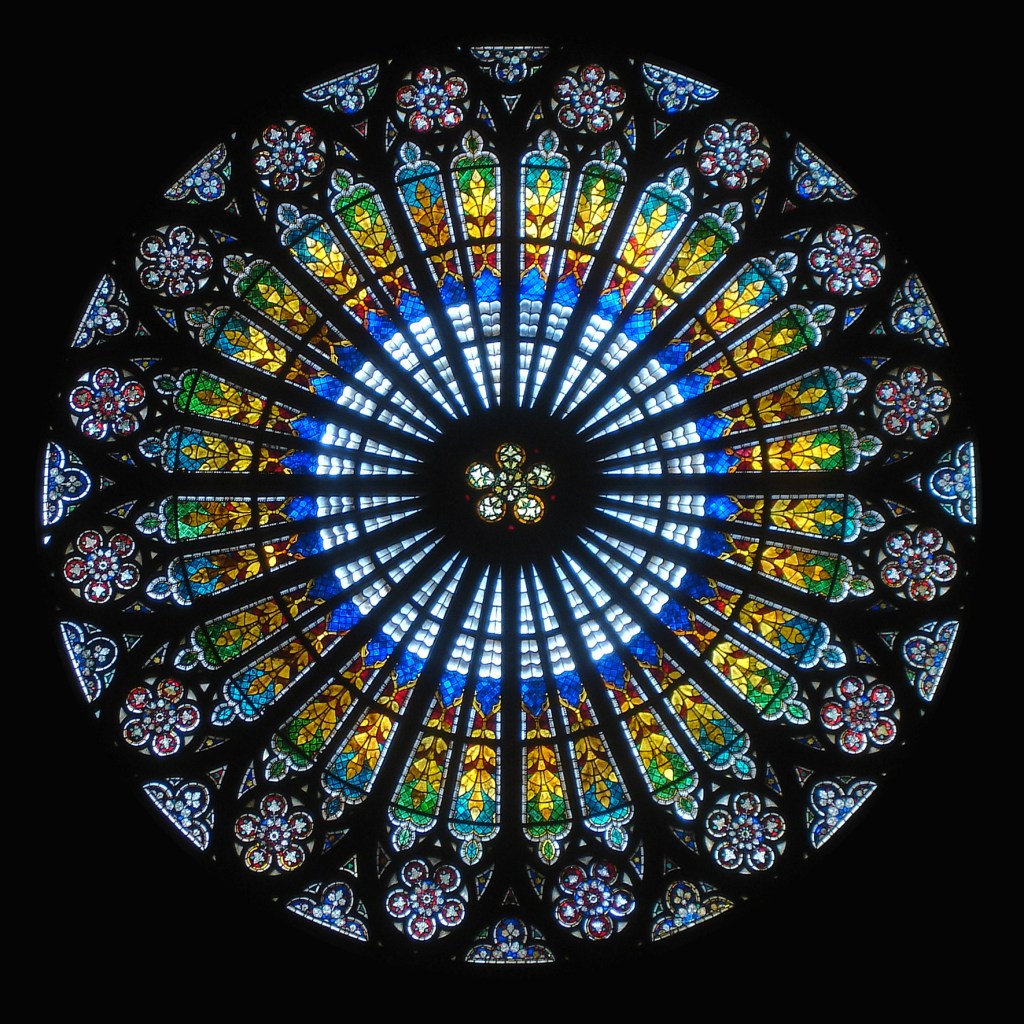
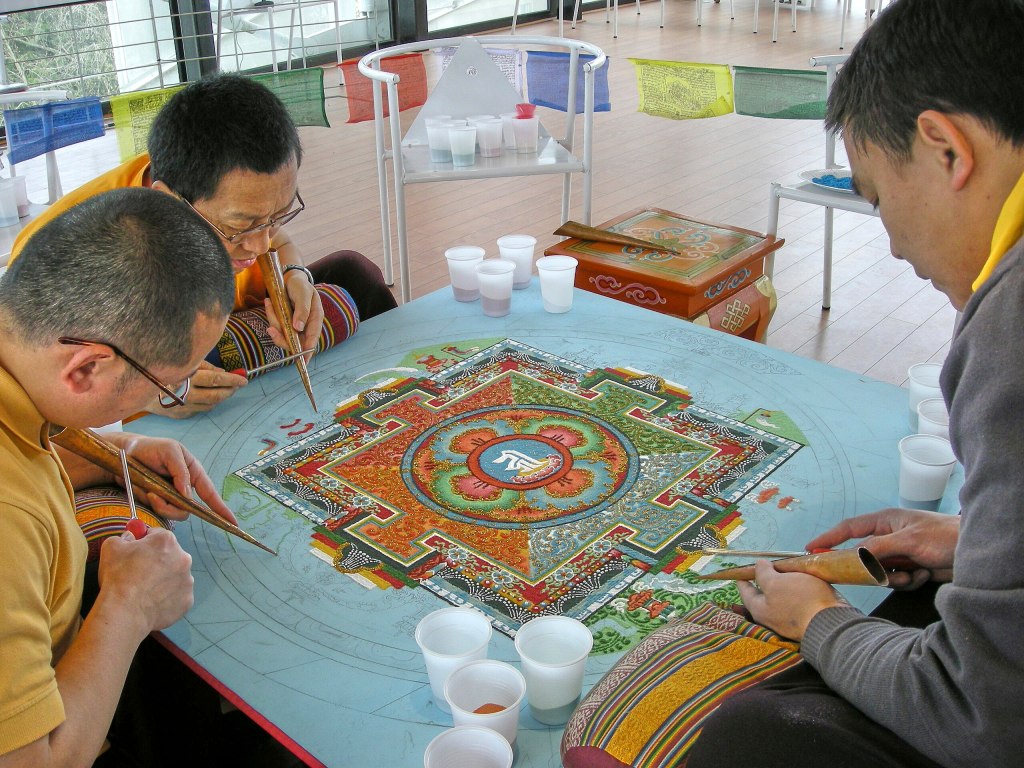
Jung himself would often use the mandala as a symbol of the psyche. To Jung, the mandala came intuitively expressed in his artwork, before he understood what it meant. The mandala though is an ancient symbol. Tibetan Buddhists have mandalas, the Hindu have mandalas. Christians express mandalas in the rose windows of cathedrals and churches often. To Jung, the mandala symbolized the Self, the totality of the psyche which encompasses the conscious mind, the unconscious and the collective unconscious. We can see in just a few examples below how this symbol appears again and again around the world.



FRACTAL LATTICEWORK OF THE MIND
In the past year I have explored this idea of the mandala, and considered that perhaps the mandala may represent a static snapshot of what is, in reality, a dynamic, ever changing fractal mandala, a moving image that represents the psyche.
A way to imagine the mind — or the psyche or even the soul — is being this essence of Self suspended and lifted from the landscape of our unconscious and perhaps the collective unconscious mind.
Now, simplify this vision by picturing a three-dimensional mandala, in a sphere. Imagine it animating, folding inward like a flower, or shifting like a kaleidoscope in motion. This motion reflects the fluidity of our thoughts, moods, and our self-identity — our ego to borrow Freudian terminology.
This kaleidoscopic mandala represents the ego: the essence of how we identify ourselves, the narrative we construct about who we are. For most people, this ego-self is what they perceive as the entirety of their being. It’s shaped by the interplay of nature and nurture and rises from the conditions of the brain.
Now, envision this fractal kaleidoscopic mandala as the core of our Self experience. Picture it supported by a latticework of fractal tendrils rising from the unconscious and collective unconscious.
These fractal tendrils become a framework — a support structure — that upholds our sense of self, our ego, and the narrative of our lives.

Some of these fractal lattice pathways are healthy, forming support structures for our sense of self rooted in secure attachment. Others, however, may be corroded by neglect, trauma, or abuse. Imagine these corroded pathways as a different color—dull or fractured—distinct from the vibrant hues of healthy fractals. What colors might you envision for healthy fractals? And how would the unhealthy latticework appear?
HEALTHY LATTICEWORK
Picture the latticework of the mind expanding and strengthening through our passions and interests. These pursuits—whether becoming an athlete, writer, artist, musician, healer, mathematician, or scientist—create new, healthy support structures that reinforce the fractal essence of our consciousness.
Even in the face of hardship or insecurity, staying engaged in life fosters growth. Curiosity, hope, and trust inspire the development of additional latticework, creating a resilient framework that upholds a healthy sense of Self.
SHADOW LATTICEWORK
Now, imagine the opposite. When the scaffolding of our ego-self is incomplete due to gaps in attachment or developmental wounds, vulnerabilities emerge. These gaps may invite self-doubt, critical inner voices, lack of motivation, or other symptoms of depression and anxiety. Over time, the base of the fractal tower begins to erode.
Without healthy supports—like a loving family, self-care, or meaningful engagement—we may attempt to compensate with shadow latticework. These structures, born of avoidance or desperation, can take the form of substance use, workaholism, or the relentless pursuit of wealth or status.
While these shadow latticeworks rise from the collective unconscious and offer temporary support, they also wrap around the fractal essence of the Self, draining it. Instead of symmetry and balance, there is distortion, disorder, and depletion.
DAVID GOGGINS & CHOOSING A NEW LATTICE

David Goggins is a retired Navy SEAL, an ultramarathon runner, endurance athlete and motivational speaker and author. In his book Can’t Hurt Me: Master Your Mind and Defy the Odds, Goggins discusses his tough upbringing and some of the unconscious latticework (my words) that he developed early on to survive.
Although he had a vision of joining the military he admits that in order to pass through school he found himself cheating to get by, and thinking that it wouldn’t matter because he was joining the military. Then as a junior in high school he was forced to take a hard look at himself when he took the examination to get into the airforce. His score of 20 was too low to get in and he realized his cheating and not trying had hurt himself.
In a scene from the book Goggins, who says at this point he was essentially raising himself, took a hard look at himself in the mirror. In what can be called a transformative moment he shaved his head and talked to himself saying:

Goggins spontaneously leaned into a rite of passage. Lacking a rite of passage of his own, and a community and family to help guide him he created it. The shaving of this head though coincides with the hair cut that often is part of the rite of passage for boys as they transition into manhood.
If Goggins had relied on a lattice work of dysfunctional behavior to support him in his life before this, now he was waking up and realizing the nature of what was supportig his sense of identity. He took control in those moments and would have to continue to take control to see his vision come to fruition.
This is again what I have referred to in past articles as grappling with our annihilator. Goggins could have gone the route of stuffing his feelings with food, alcohol, drugs and other behavior. Instead he learned to face himself, be honest with himself, and for the first time challenged himself. In some ways perhaps Goggins also tapped into that ancient place in humans, the warrior within. Like a Spartan from Greece, his hard life would mean something and be turned to serve, rather than skating through life barely here.
He began to create a new latticework for his life, based on facing adversity and challenges rather than not facing it, and this has become a large part of his motivational speaking message.

David Goggins went on to become a Navy SEAL, completing one of the most physically and mentally grueling training programs in the world. His journey was anything but straightforward—he endured three attempts to complete the training and successfully finished Hell Week twice. Goggins served two tours of duty as a Navy SEAL before retiring due to a necessary heart surgery.
David has completed over 60 ultramarathons, utratriatholons and endurance races. If you think this is because he just has the gifted life and genetics keep in mind his determination despite having very bad knees and enduring two heart surgeries. Consider too, that he weighed 300 lbs when he decided to change his life.
This isn’t meant to make anyone feel inadequate about their own lives, but rather to highlight the importance of the philosophy we bring to them. Our drive and motivation are deeply connected to the outcomes we achieve. What we believe about ourselves shapes our reality. As David Goggins often emphasizes, if you don’t believe in your ability to accomplish something, you’ve already set yourself up for failure.
CONCLUSION
In reflecting on the fractal mandala as a symbol of the psyche, we can imagine each mandala of consciousness emerging from the collective unconscious — a fractal landscape that connects us all. These mandalas are shaped by our ancestry, by the conditions of our upbringing, and the milestones of our development. We can see though that this latticework is shaped also by the choices we make, which includes believing we can influence the outcome of our lives, and actively shape who we are.
David Goggins exemplifies this principle. He speaks often of accountability, of strengthening the mind by confronting weaknesses, and of embracing life’s challenges—including the fears that hold us back. His story reminds us that transformation is possible when we take responsibility for our growth and consciously rework the latticework that supports us.
If we envision the soul or psyche as a fractal mandala—an intricate, dynamic, and ever-evolving pattern—we may grant ourselves greater permission to change, grow, and embrace life’s challenges. This perspective allows us to view disappointments and failures not as endpoints, but as opportunities to deepen and enrich the ever-unfolding expression of who we are.
—————————————————–
endnote: I began this article about fractal mandalas this past week while my son Everest was home from college for winter break. While driving back to the airport early in the morning in a snowstorm he brought up David Goggins and we talked about his relentless pursuit of goals, and how he shaped his life, and continues to embrace change and inspire others. This conversation inspired me to read David Goggin’s book, listen to him in interviews and integrate some of his experience into this article briefly. I’m grateful for my sons for being able to discuss deep topics such as this.
 Follow Your Myth