I’m thinking about self identity a lot this week. I found myself recommending a film twice when discussing parts of this subject with clients. I’ve written of this film before, it is the magician Derek DelGaudio’s, In and Of Itself.
In this film DelGuadio, a magician from Colorado, creates a stage show which centers around the question, who are you? At the beginning of the show the audience is asked to choose from a list of options on a wall to identify themselves. The show is a series of stories punctuated by magic and mentalism, woven by DelGuadio. The audience is very much a part of the show, I’ve written before on this topic below but as I’m revisiting self identity it’s worth revisiting this first to explore a little more as a jump off point. It is also worth noting again, that there is a tie between what humans find entertaining and our ability to feel something come up from inside that expresses an inner truth. This is in itself intertwined intimately with the arts such as storytelling, fine art, music and performing arts.
https://followyourmyth.com/2023/08/09/psyche-magic-self-identity/
The implied question by Del Gaudio, “who are you?” is just a more recent and entertaining foray into this idea. What makes it most engaging is that the audience feels they are part of the show in a meaningful way. This itself breaks down the separation of a perceived show, and the audience who typically is observing the show. As DelGuadio surprises the audience by bringing them into the show deeper and deeper, we are left to ponder how it is done. More importantly we ponder the role we, as the audience, chose to play by making a choice of how we identify at the start of the show.
Like many human stories, this show builds on very old stories that humans have shared for thousands of years, the most obvious is the Parable of the Blind Men and the Elephant, which originated in ancient India and can be found in Buddhist and Jain texts. The second does not appear overtly in the show, but it is also present. It is the Allegory of Plato’s Cave.
What these stories do is ask questions about how we identify ourselves, and our philosophy of life.
PLATO’S CAVE
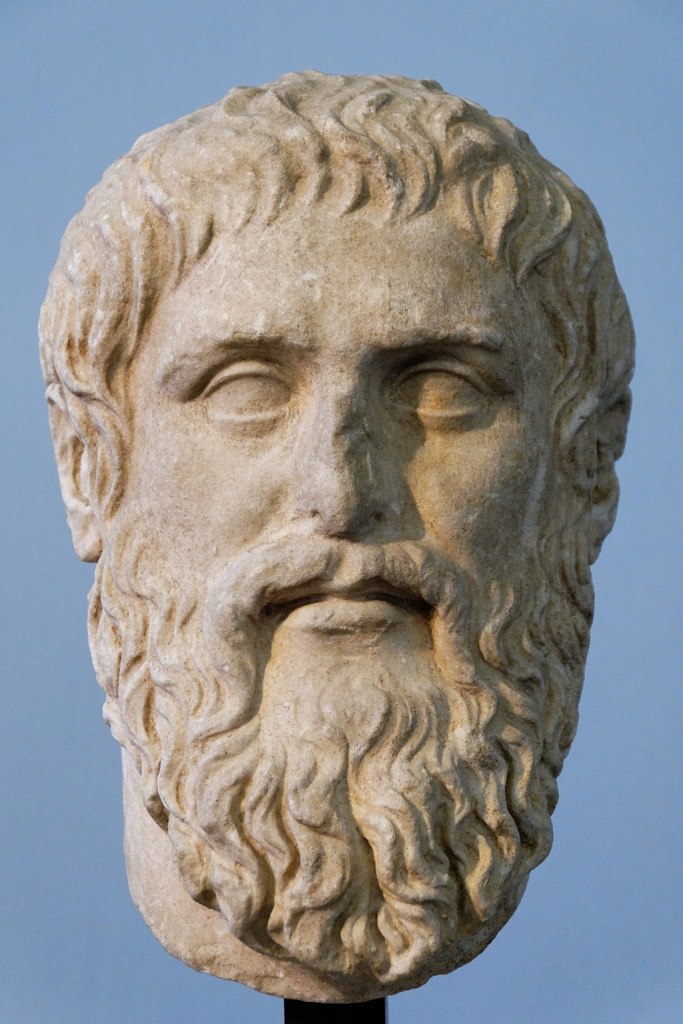
In Plato’s Allegory of the Cave, Plato the ancient Athenian philosopher, tells the tale that we can think of as self-perception, and how we perceive our part in the world. This allegory appears in The Republic, written around 375 BCE.
Consider that in Plato’s story he envisions prisoners chained in a cave and only seeing shadows on the wall, cast by people they cannot see behind them. Their perception is that the shadows are reality. One prisoner escapes and leaves the cave to see that the shadows were an illusion. The prisoner emerges into the bright sunlight, realizes the truth, and eventually returns to the cave to set free the other prisoners. The prisoners do not embrace him or the truth he tries to share – instead they reject him and his ideas that there is something beyond the shadows they perceive as reality.
It isn’t clear if they are afraid or simply too comfortable in their world view.
This allegory can be seen as representing our life journey as humans, where for much of our lives we accept a certain way of moving through the world. It could be that Plato is challenging our very notion of reality, and what consciousness is. He challenges our idea that what we perceive to be reality *is* reality, and he therefore challenges what it means to be alive.
There are expectations on humans, and often we flatly buy into many of the expectations of what it means to be. As we make our way through the world – life may challenge our perception of what we are doing, and why. It may challenge our very self-identity. It may challenge our sense of “who we are.” It may challenge whether we feel safe, seen, and loved. It may challenge our understanding of why, we do what we do.
Philosophers like Plato hold up a mirror to the way we move through life, inviting us to reflect on our own perceptions. They also challenge the notion that we can move through life without a personal philosophy. Yet, we often drift through life like a dream, rarely questioning the shadows on the cave wall or the beliefs we take for granted.
It’s worth noting that even Nihilism is a belief system—one that asserts nothing has meaning or purpose. Whether we choose to embrace a philosophy or reject the need for one, we are still making a choice about how we understand our place in the world.
THE ELEPHANT & EPICTETUS
As I said, DelGaudio speaks of the Blind Men and the Elephant in his stage show, asking at times if we have seen the elephant on stage. In DelGaudio’s explanation the blind men wrestle with describing this animal, and to DelGaudio this is about how we identify ourselves, and how others may identify us. Do you identify as a father, mother, sister, brother, doctor, lawyer, actor?
The parable that he chose is a very old parable though, and is not necessarily about self-identity, at least not in the way that DelGaudio chose to use it.
This parable is closer to Plato’s allegory of the cave. It is about how we understand the nature of reality and the universe. It notes that we can only experience part of reality, and if we understand this it may show us that our limited views of reality are grasping to explain something that is difficult to perceive. Humanity is compared to being blind, and this is similar to Plato’s Cave.
The distinction here is not to say that self-identity is not part of this parable but that we are also sensing into something else, what this human experience is all about – which becomes a bigger more existential question.
These things are important because our perception of reality, and who we are, is tied to our sense of belonging and purpose in life, which become touchstones to how we move through life.
To have a sense of purpose is tied to self-identity. To make choices in our life allows us to feel that we are living with purpose. Now I understand that some with say that they have no choices in life, but we always have a choice about how we approach life.
Consider the Greek slave Epictetus.
Epictetus was a Greek Stoic philosopher, born into slavery in the first century CE. Despite being a slave, he cultivated a deeper inner freedom through philosophy, believing that although we cannot control external circumstances, we have complete authority over our own minds and attitudes.
Eventually given his freedom, Epictetus established a school where he taught that suffering comes not from events themselves but from how we interpret them. His teachings, later recorded by his student Arrian, emphasize resilience, self-discipline, and the pursuit of virtue as the foundation of a meaningful life.
Epictetus exemplifies the idea that we always have a choice in how we respond to life’s challenges, and this wisdom preceded modern psychotherapy by nearly two thousand years. In particular we can find this brand of thinking folded into cognitive behavioral approaches of psychotherapy. My problem with CBT, “cognitive behavioral therapy” is that it rationalizes philosophy into psychological tools, and flattens it into a materialist approach to the world, which in some way also undermines it. This flattening happens right in the the name, “cognitive behavioral” which implies that we are simply a series of reactions in a wet computer brain – and this is not, in my opinion aligned with the philosophy of Epictetus.
Although CBT may have been inspired at some level by Stoic philosophy, it is not an approach to psychology that uses philosophy itself as a tool of understanding oneself and life. CBT is rooted in empirical psychology and focuses on identifying and changing thought patterns and behaviors to improve mental well-being. While it draws from Stoic ideas—such as the notion that our interpretation of events, rather than the events themselves, causes suffering—it does so in a way that is pragmatic and stripped of broader philosophical inquiry.
Epictetus, like Plato, was addressing existential approaches to life, and how our sense of purpose cannot be taken away, based on what we believe in, and how we perceive life. Building this worldview takes time though, which CBT does not often afford someone in psychotherapy as they are looking to deliver quick *tools* to address symptoms, rather than addressing an underlying worldview. This is also in part driven by an insurance system in our world, that is looking for quick fix approaches to life, rather than seeing the existential dimensions of the human experience, that is difficult to pin down.
PSYCHE vs PSYCHO
We jump back to where modern psychology begins with the approaches of Sigmund Freud and Carl G. Jung who again folded into their work ancient wisdom, mythology and dreamwork. They addressed the very idea of the unconscious self that drives our behavior.
Jung and Freud both come from the Depth psychology approach to psychology and yet – a split was to come between their approach to psychology. As depicted in the film A Dangerous Method, (based on the book A Most Dangerous Method) briefly disagree on the difference in the words psychoanalysis and psychanalysis. The lack of the “o” in Jung’s version of the word put the emphasis on psyche, which comes from the greek word for spirit, or soul.
In the film Freud prefers the more scientific sound of psychoanalysis, which underscores the scientific approach that Freud took to the subject of psychology. This tiny snippet of conversation underscores the difference between Jung and Freud in an important way, and hints at their eventual rupture. Freud, wished to have psychology taken seriously like any of the sciences – while Jung preferred to speak of the psyche, matters of the spirit.
This is emphasized by Jung in his writing, in the Practice of Psychotherapy, where he talks instead about psyche with the “e” intact continuously. Jung’s view of the psyche was a more holistic view of the soul work one is undertaking in therapy, and thus emphasizing the psyche that is missing from our modern approach to psychology.
That lack of a simple “e” invalidates life as a soul-journey.
There is a divide here that is hard for me to easily quantify and explain in a short paragraph or two. It is a difference between a materialist view of the world and a more existential approach to life. It is the difference between thinking of the human mind as a computer to be re-programmed, rather than a person on a life journey.
It gets back to the question of how we see ourselves, how we identify the elephant, and what we think is behind the shadows projected onto the wall of Plato’s cave.
PERSONAL PHILOSOPHY
I want to be clear, I am not hawking religious beliefs here, and demanding that one believe in god or a religion. Existential questions are not the sole domain of religion, although as a Depth psychotherapist I believe that myth and religion offer much to the discussion.
These are human problems, and as underscored with Epictetus, they can be philosophical, and non-denominational, and universal.
In general it begs us to ask the questions of how we see ourselves in our lives, and to continually re-evaluate the life journey we are on, the choices we make and even the ancestral psyche we may carry with us. It asks us to keep evaluating what it is we believe, what is our philosophy and approach to life, and whether no philosophy, is still a philosophy of nothing.
 Follow Your Myth