In my first article on psychedelics, I explored the background around plant medicines, centering on mushrooms, and considered how a Jungian may navigate the unconscious imagery that rises in a journey. I concluded at what I refer to as Liminal Consciousness.
In this second part, I want to explore Liminal levels in greater depth and continue the descent into Trance states. By breaking down the stages that may unfold in a psychedelic journey, my goal is to map the inner landscape of these altered states, offering a framework for others who wish to navigate these depths.
A NOTE ON WORD USAGE AS INTENTION
Language often reveals intention. The words we choose, can shape, or even determine the trajectory of a psychedelic experience. When people use words like “getting high” or “tripping,” the language acknowledges a casual and recreational use of these plant medicines.
The use of these words implies intention, yet I suspect that a fair number of people may experience issues because they may not feel “high” or elevated. Instead, they may feel the medicine pulling them inward as though they are caught in the gravitational well of something bigger than the pleasure they sought. Psychedelics are not narcotics, they are not pain killers, they are mind revealers.
This is why I encourage the use of words such as “going deep” or “journeying” when working with plant medicines such as psychedelic mushrooms. These words carry a sense of purpose and respect for the medicine. They help focus the mind toward exploration, receiving, and insight, rather than relieving symptoms.
I believe two things can happen when people use psychedelics. A casual user may feel an invitation to go deeper, which can feel disorienting and frightening. This may be because the medicine responded to an authentic need.
On the other hand, someone may be intentionally journeying, and find themselves stuck going nowhere at all, and this could be an indicator that more preparation should be done before going on a journey.
With this note about intention out of the way, we can continue to descend into the journey to see what else may be found.
TAKING THE ELEVATOR DOWN
A way to think of the downward (and inward) descent into the levels of the unconscious is to think of it like taking an elevator down levels. Imagine taking this elevator down through the levels of the mind, and with each descent, more may unfold from the deep unconscious or the collective unconscious. The first stop of this descent into the personal unconscious is what I refer to as the Liminal Unconscious or Liminal Consciousness.

Our psychedelic elevator may stop at this Liminal level, and I suspect it stops around here often for casual psychedelic use, because so much is linked to intention. If one is simply using casually, then there is no set intention that may invite the elevator to descend yet again.
There are more stops on the way down before reaching Trance states, let me talk more about the possible experiences in Liminal states, where the elevator might stop on the descent, and what may bubble up from those lower levels even when we stop the descent.
LUCID LIMINAL vs SPECTATOR LIMINAL
As a journeyer slips into liminal states of the personal unconscious, there are two directions the journey may unfold. One direction is supported by a presence of mind and feeling lucid. This Lucid Liminal state is amplified by all the right conditions, as discussed, like setting intentions. Insight appears to unfold naturally in this receptive state.
In the opposite direction is where one may slip into spectator mode. In spectator mode, I suspect one simply gets lost in the imagery and the feeling, most often describing the experience as “tripping.” In this state, there might be no receiving of wisdom, insight, or understanding. Spectator mode may still reveal a sense of expansiveness of Self, and a feeling of warmth and connectedness to something bigger than self.
I believe lucidity allows for both intellectual and emotional insight during a journey, whereas slipping into spectator mode may lead to emotional satisfaction or – dissatisfaction— depending on how the journey continues to unfold. This dissatisfaction comes from the dreaded “bad trip,” a disorienting and sometimes scary experience that feels difficult to extricate oneself from, which I will discuss next.
BAD TRIPS: ONLY WHAT YOU BRING WITH YOU
Preparation greatly influences the outcome of a psychedelic session; this has become clear over time. Should a “bad trip” occur, I believe changing elements of the set and setting may help to change the experience. In this case, changing the lighting, getting support from a sitter, or changing the music may change the conditions that lead to what seem to be more aligned inner states. These aligned states seem to be accessed when intentions, are in alignment with all the other amplifiers in a session, such as the music used.
It is possible though that conditions *before* the session were taken for granted, and the mood one was in, or other experiences one is having affect the session. In these cases, it could be that one has not prepared enough.
These are the internal things that we take into a session with us.

Perhaps George Lucas was onto something when he wrote the training scene with Luke and Yoda in The Empire Strikes Back. In one scene, Luke comes to a cave and, feelingsomething, he asks, “What’s in there?”
Yoda simply replied, “Only what you take with you.”

Luke straps on his lightsaber and ignores Yoda’s admonishment to leave it behind. He goes in with his fear and whatever other emotions were present, and in that space, he faces himself in a very archetypal way.
Everything is an amplifier in a psychedelic journey, and indeed, what one brings into a journey, into that cave, will be with them. This isn’t just metaphor anymore in this state. We aren’t watching a film; we are participants in a powerful altered state where it is *you* descending into the cave to face something big – except that in a bad trip, these things may be far scarier, overwhelming, or disorienting. If you are feeling depressed, angry, anxious, or upset by something, then these things will follow you inward, and you may find yourself, like Luke, facing more than you had bargained for.
LIMINAL THRESHOLD EXPERIENCE
In the opposite direction of a casual experience is the stillness that one comes to when they embrace a journey, going toward it like a meditation. I believe that in this act, there is stillness of mind and body, which can help to amplify the experience, just as it does for meditation.
When we stop engaging our vestibular system, which governs our sense of motion and balance, and allow our brain to orchestrate the experience, then we can fold inward more deeply. This is partly why I believe someone experiencing psychedelics at a concert, for instance, may not have the same experience as someone who is still, and in a controlled setting.
Combined with the stillness of body is a stillness of mind. This is where we can settle our attention on one thing in our mind, and this, I believe, can allow the process to deepen, just as it does for meditation.
Between the Liminal state of a psychedelic experience and the trance state is what I currently think of as a Liminal Threshold experience.
This experience is important to validate, in that those who do not slip into a trance state (not all substances produce trance states) may still enter a deep state where personal insight is revealed. This is where one allows the music, the meditation, the medicine to speak directly to them. The journey may feel profoundly personal, as though a presence is impartingwisdom. I am saying that this mind state appears to help someone reflect on their journey in this lifetime, and potentially see themselves more clearly. One may see how and why we move through the world as we do.
From a neurological perspective, we might explain that all regions of the brain are firing together and orchestrating new information to come together. Old habitual pathways may be pruned during this experience and real insights may result.
This may not all happen in one sitting, though. When the journey is done, the processing continues over time, in order to understand and integrate the experience.
This Liminal Threshold experience may be the deepest some journeys go, but there are still more levels to descend to in this psychedelic elevator. The inward journey with mushrooms that is supported with proper preparation may lead to trance states of consciousness where a connection to our ego self is temporarily left behind. From here, the path can lead beyond personal reflection into states that feel less anchored in the self as we usually know it — what some describe as a dissolving of boundaries, and what others experience as stepping into a vast, shared field of awareness.
TRANCE STATE OF CONSCIOUSNESS
Inherent to altered states of consciousness is that mystics, initiates, and modern journeyers alike often seek entry into trance states—these are deep, immersive states of being, where the usual structures of ego consciousness are suspended.
Trance can be entered through many traditional means, such as yoga, rhythmic dancing, pain rituals, fasting, breathwork, or deep states of meditation that may come from a great deal of practice. It is argued that psychedelic medicines have always been part of the human toolkit to act as catalysts for these trance states, dating back to ancient times, and that this practice informed many of the others.
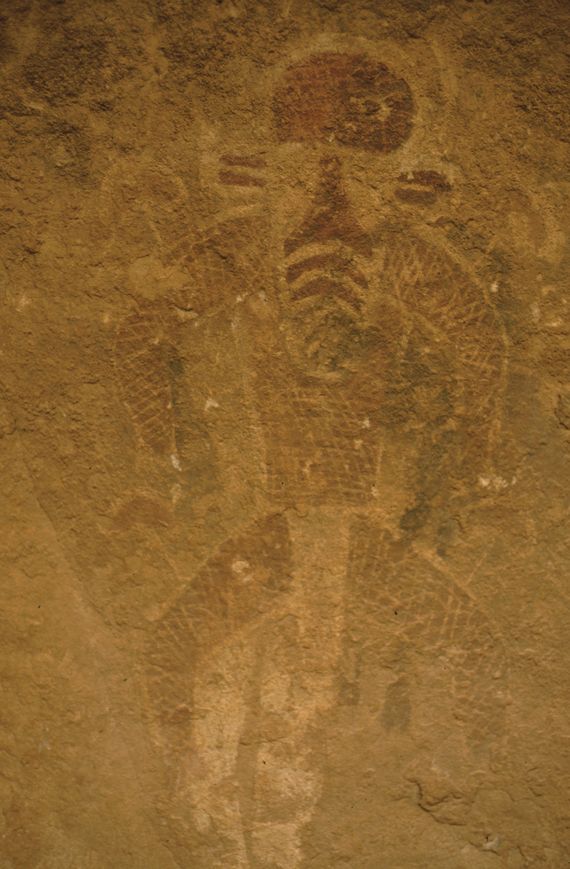
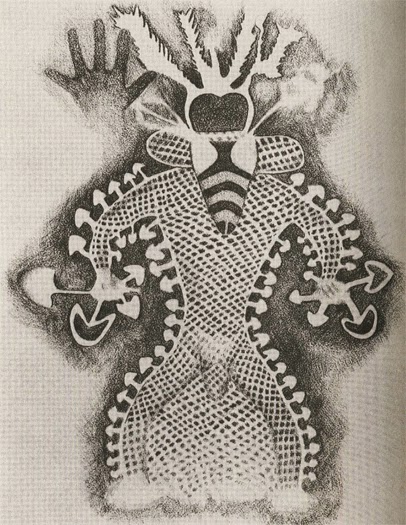
There is even evidence from cave paintings that suggests that ancient shamans used mushrooms to achieve trance states early in our history. In this cave painting below we see evidence of a shaman etched onto the cave wall, on his arms and legs are mushrooms.
If the first level of descent using psychedelics takes one to the Liminal state, the personal unconscious, and Liminal Threshold states, then the experience of trance state is much deeper.
Trance appears to be an inward state where our sense of time and space are lost. The journeyer in this deep state seems to be lucid, while they journey inward and no longer have a sense of their physical body. It goes deeper, though, in that the journeyer in this state seems to feel bigger than the way they perceived themselves as an individual. It is at this level that one may have a sense of connectedness to something vastly larger than the individual self — a presence, an expanse, or a unity that ancient mystics described with terms such as Brahman, the universal consciousness. In this moment, it may feel less like “I am a person having an experience” and more like “I am part of the totality in which all things exist.”
If we think of the self as a wave upon the ocean, this state can feel as though our identity flips — instead of being the wave, we are the ocean itself.
TRANCE STATE: CONSCIOUSNESS FLIPPED
Jung’s model of the Self presents consciousness as a hierarchy: the conscious mind at the top, beneath it the personal unconscious, and at the deepest level, the collective unconscious.
Although we don’t realize these states of consciousness are always active and always accessible, they likely reveal themselves to varying degrees all the time. An obvious example is when we dream, but perhaps also when we fantasize, play, or daydream. Jung explored these states himself, in what would become known as “Active Imagination,” which involved dialoguing not just with parts of himself, but also with archetypal figures like Philemon, the wise man.
Another access point is through creative acts like writing, creating art, and music. When we enter a flow state during creativity, we may feel as though something greater is flowing through us, and this flow state may be accessing those deepest parts of our Selves.
Now imagine flipping this image of the top-down image of our Self. On a psychedelic like psilocybin, the active ingredient of mushrooms, the conscious mind recedes, and the personal unconscious and the collective unconscious come to the fore. One may slip into these deepest unconscious realms and report that the essence of the feeling is an upside-down representation of Self. A journeyer may describe feeling united with that universal consciousness (referred to as Brahman in Hindu philosophy), as though their ego self has dissolved or receded, even while reporting lucidity.
In trance states, when ego identity fades, one feels a sense of merging with deeper realms. This is not at all like a dream state experience, because in this state our sense of “self” feels distant and illusory, revealing what may be a truer essence beneath. This may feel so profound that coming out of a trance state may profoundly reshape one’s perception of life
CHOP WOOD, CARRY WATER
As the Zen saying reminds us, “Before enlightenment, chop wood, carry water. After enlightenment, chop wood, carry water.” In the same way, a trance state, or the Liminal Threshold state, may feel as though they reveal vast, indescribable wonders. The task remains that we must do the work of life.
The work may not literally be chopping wood or carrying water, but the mindset is the same. Approaching altered states with intention, teaches us that all life can be approached with intention.
We reinforce the novel neural pathways that unfold from these experiences, but that does not mean chasing the next journey. This is done by staying with the work afterwards. If the goal is to understand what we carry in life and what we believe its purpose to be, then we keep that experience alive. We process in talk therapy, in journaling, in dialogue with parts of ourselves. We integrate what we received, even if we don’t yet understand it fully. We do this by continuing to reflect on the experience.
In this way, chop wood, carry water can be expressed as process, integrate. We continue the work because each day we wake in this human body, with human challenges, and that is all part of this waking life journey.
 Follow Your Myth