UNCONSCIOUS SHAPING
I often talk about different practices in our lives to help ground ourselves and find insight. These practices often center around journaling, meditating, or expression through the arts. Some of this is simply about being present for our lives; another reason is being present for our pain or things we are trying to work on. We often feel we are alone in experiencing our particular type of pain. I think this may keep people from taking a look at themselves because layers of shame prevent them.

I also discuss finding strategies for managing life’s challenges rather than merely coping with them. A coping mechanism may look like drinking whiskey; it may temporarily dull the pain and turn down the volume of the voices that bother us. It doesn’t have to be alcohol; Gabor Mate talks about being a workaholic, which is another unconscious strategy for dealing with internal discomfort. Gabor Mate, in an interview, is quoted as saying;
So, I was a workaholic physician for many decades. Why was I a workaholic? Because the message I got as an infant under the Nazis was that the world didn’t want me. And if the world doesn’t want you, one way to cope with it is to make yourself very important, become a helper, become a physician, because now they’re going to want you all the time. But that’s very addictive, because you keep trying to prove to yourself something you don’t believe in the first place, which is that you’re wanted. And so that the more people rewarded me with — either financially or with their attention or their gratitude for my medical work, the more I needed it, the more I became dependent on it. So, it shows up in so many ways.
The opposite of a coping mechanism is finding a strategy and going toward something that is on our mind and processing it in some way, like journaling.
Another method might mean channeling hard feelings into expressive artwork because we aren’t in touch with the words at this time. It might mean processing in other ways, such as music, dance, acting, or creative writing.
An example is Motoi Yamamoto, who makes salt art. Motoi’s art was inspired by loss and a ritual that involves salt in Japan. Just ritually scattering salt to address his grief for his sister who died was not enough. Motoi took this ritual and expanded it into a very personal art, which still acknowledges the impermanent nature of life. Motoi’s installations help others experience his art, and perhaps feel some of what is being communicated at other levels.
You can see some of Motoi’s incredible artwork below and hear some of his story.
Motoi Yamamoto is doing something I also refer to as “shaping.” This is a word that has floated up from my unconscious this summer. It seems to be a small spontaneous insight that comes up from feeling good, doing different things, while also being able to drop into a reflective space. I’m working in the garden trying to redesign the garden and I hear the words, “you are shaping.” I go to the creek to tend the pathways along the creek, and again, “shaping” floats up.
To me, it’s an archetypal word; it’s not exactly sculpting the environment, it feels older, and it hints at impermanence and collaborating with the environment or even tending. It speaks to a way that we are also shaping our own psyches with the ways we interact with the world in our daily lives. We shape our world, and we shape our psyches, and there is a connection in all these things we do.
ANCIENT SHAPING
This idea of shaping our lives seems like something very old. I suspect that ancient peoples began shaping and interacting with the world around them from the start. We look to the megalithic structures of the world to point to when humanity began to “build” things and organize.

This is false. You don’t start a culture by building pyramids and stone henges. You begin by weaving grass into baskets or packing mud into a bowl that is put over a fire to harden it. You make pathways along rivers to find food and may begin to place stones to make it easier to find your way. It likely began with playful acts of exploration with stones, sticks, grasses, and dirt of different colors.
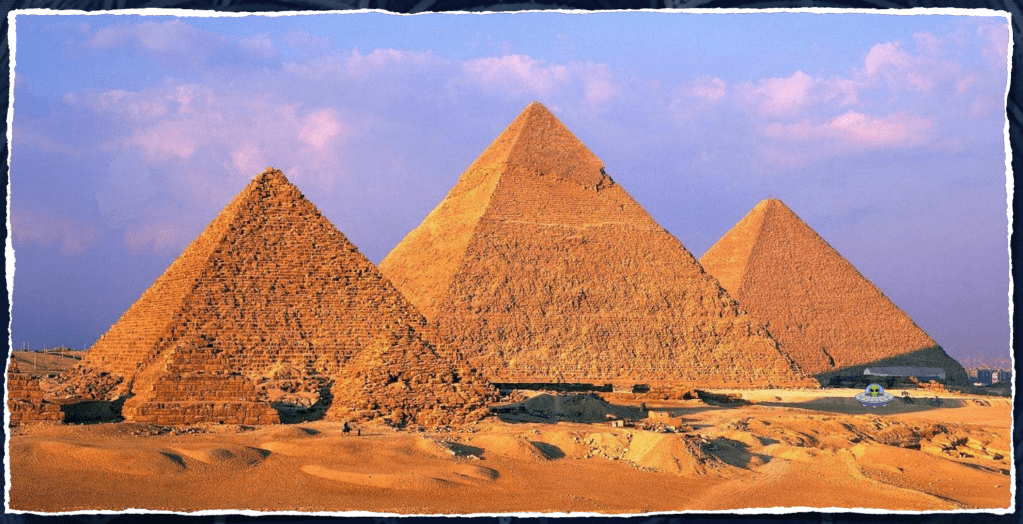
These acts were likely as impermanent as Motoi Yamamoto’s salt art for tens of thousands of years before we began to cut megalithic stones. We see evidence that has survived for increasingly longer periods – cave paintings such as in Lascaux in France, dated between 17,000 – 22,000 years old. Older still, Chauvet is dated between 30,000 – 32,000 years old.
The oldest human cave (so far) is from Indonesia, dating to 51,000 years old. If we go outside homo sapiens, we still find older paintings that were likely made by Neanderthals dating to 64,000 years old.
These caves show that humanity has had a need to express something, to shape and interact with our environments, and this scant evidence shows it is something humans have been doing a long time. We make assumptions that these are examples of when humanity began to create, but they are simply what has survived the inevitable erosion of history.
ANIMALS SHAPE
Humanity likes to think of itself as unique, and for thousands of years has tried to prove its uniqueness over other animals. We have thought our big brains made us unique, or perhaps language, tool use, or what about the ability to grieve, or feel pain? Humanity moves the boundary of what we think makes us special and outside nature, selectively ignoring the evidence of connections between ourselves and nature.
We always seem surprised when we see other animals acting in ways we think are human, such as when a dog grieves a loss. Perhaps when we see the intelligent curiosity of an octopus. We can keep drilling down, though, into how animals also shape the world around them. The Weaver bird which weaves complex and beautiful nests to attract a female mate.
Or what about the White Spotted Pufferfish, which creates a mandala in the sands to also attract a mate (that image below is the drone they are using to study the Pufferfish, which becomes clear in the video ).
THE TAKEAWAY
What does this all mean? Why do we shape our lives in this way, and is it because we are obeying an internal imperative? Some of what I’m talking about is that part of an imbalance for humans, may be a separation from some internal ways we can self-soothe, and find balance in our psyche in the act of doing something that is creative, even if temporary.
The grieving person who begins to build Lego masterpieces is bringing a shape and expression to their grief, just as an artist like Andy Goldsworthy is simply playing in nature and expressing something internal that may come from a different expressive place that touches into the more ancient practices of shaping the world. Perhaps we can look to the Buddhist monks who create beautiful Mandalas of sand only to wipe them away – speaking to the impermanent nature of life, while also acknowledging a deep meditative connection to something bigger.
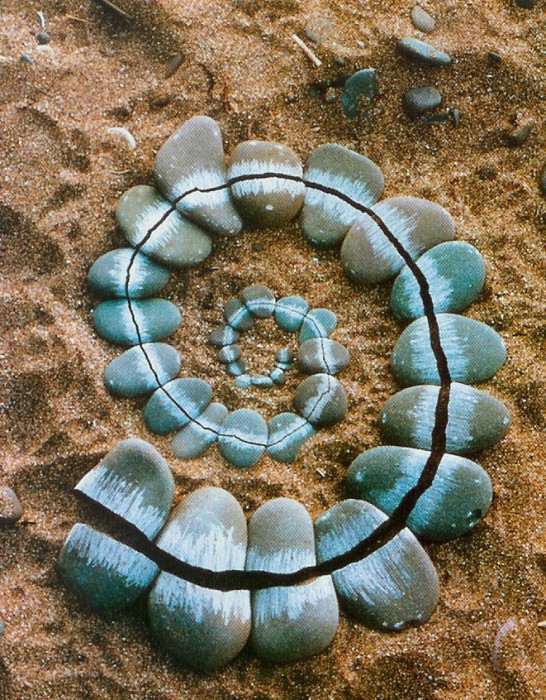

Perhaps there is comfort in finding patterns and shape to our lives, whether it’s baking or exercising. We shape our lives rather than having our lives shaped by social media, the 24/7 news cycle, or the 9-5 workday. By inviting in our own ways of shaping our lives, we can tend to something that may soothe us, in ways we don’t quite understand. We feed ourselves and find connection, rather than isolate and constrain ourselves.
We can also think of the bigger shape of our life and what we are trying to bring in. What do we imagine our life can become while we are here? Can we find ways that amplify our natural need to connect and interact? Can we identify the coping mechanisms and instead go toward strategies to shape our lives and our internal lives? Can you acknowledge that simple every day acts of folding laundry, listening to music, and being present for your kids are also shaping your life, and theirs?
Each act of shaping may have the potential for bringing connection and meaning to our lives and finding the beauty in impermanence.
 Follow Your Myth