INTRODUCTION
I often encourage clients to track the narrative of their lives as we create space to explore their past experiences. Asking someone to track their narrative, I realize, can be at times confusing, as when doing this, I am often asking them to track the details – the story of their life as they see it unfold. This is a way to make sense of our lives, and for me to gain insight into that lifetime of experiences. This is a process that unfolds slowly over time, though, and often a story first told won’t reveal the feeling sense, or the details that might emerge with time spent processing in therapy.
It isn’t always easy to explore our memories for various reasons, in part because of the sometimes-traumatic nature of life experiences. Additionally, the chronological narrative is only part of what is created in our unconscious. There is a framework for how we perceive our life experiences, in other words. To me, this is a fractal latticework that vibrates and reacts to the multitude of things that come up each day for us. Some of that latticework was created during our earliest days, months, and years, but we reinforce or dismantle this latticework daily in our lives.
Chronologically, we may picture our lives: I did this, followed by that, and then came this other thing. However, there are emotional and intellectual imprints and lattices that form from a lifetime of experiences, and these are often more difficult to understand. In the past, I have referred to them as a tapestry, but this two-dimensional image feels far too flat for what I am looking to describe, which is why, over time, I have come to experience consciousness as something far more dimensional and even fractal in nature. This will be the main focus of this article.
From a Jungian point of view, there is the intermingled story of individuation in one’s life journey. Individuation, which is the process by which we become more fully ourselves, doesn’t simply happen when we reach adulthood; this is not the finish line of our human story. It is merely the beginning of our adult individuation process.
I often say that we are capable of three things in our ongoing individuation process: we can collapse(regress), stay in stasis, or we can grow into ourselves more. We typically do one of these three things in response to stressors in life.
All these life experiences and this oscillation between collapse, stasis, and growth speak to the nature of the human mind. Mind, however, is a subset of exploring the nature of something that is of deep interest to me, the nature of consciousness itself. This is not strictly speaking a Jungian distinction, although it may fall under the umbrella of Jung’s interest in Eastern spiritual explanations for consciousness.
It may feel like an unnecessary distinction to make, but let’s consider that understanding mind gives us the framework to comprehend how we operate in the world, and it is under the umbrella of consciousness itself, which is more than simply intellect and brain functioning. If mind is the way we function, then consciousness is the larger field of how we perceive ourselves, our self-awareness. Some argue that perhaps consciousness is a field of awareness that is inherent in the universe itself, but that is far too complex a topic to expand on today.
Along these lines, I am always trying to explore ways to help people understand the nature of mind and consciousness, which is what I will explore more here.
FLATNESS OF WORDS
Before getting more into fractal mind, let me back up. I am a visual thinker; sometimes in sessions, I draw for clients. Other times I gesticulate with my hands as if drawing three-dimensionally in the air. In those moments, I am describing that fractal nature of mind and what someone may be wrestling with.
My own psychological development means that at one point, I just experienced Jungian terms as words. There is nothing wrong with words, but as my understanding and experience have deepened, I realize that words can sometimes also feel flat. They don’t fully embody the nature of mind, and that sense of “this is who I am.”
I describe the mind using a Jungian framework: the conscious mind, the unconscious mind, and the collective unconscious. This description is not very visual. Jung himself had a rich visual dream, which explores the nature of the mind visually as a house, which I have written about in previous articles. His description can be found in Memories, Dreams, Reflections.
When I draw for clients in the simplest terms, the mind, I steal my visual from Freud. Freud imagined the unconscious as an iceberg, so I began to draw for clients Freud’s iceberg, but used Jungian terms to expand on the visual. In conjuring visual imagery for someone, I am seeking to help them navigate their psyche so that they can make space for not just what is on the surface, but what goes on beneath. So let me briefly look at this first metaphor, the iceberg.
THE ICEBERG AND THE OVERVIEW EFFECT
It was Freud who imagined the mind to be like an iceberg floating on the ocean, and he saw the tip of the iceberg as the conscious mind. Just beneath the water and accessible to the conscious mind is what Freud referred to as preconscious, and the largest part of the iceberg hidden beneath the waves, he saw as the unconscious.
I have drawn this many times for clients and groups over the years to try to express what the mind is like. The mind is the iceberg floating in the ocean.
As a Jungian psychotherapist, I would use the iceberg metaphor with Jung’s twist. The consciousmind, for Jung, was the bit above the water; the unconscious was the entirety of the submerged part of our personal unconscious. The ocean itself, for Jung, would be the collective unconscious where the mind at large holds archetypal imagery that we inherit from a vast reservoir that we all have access to.
These descriptions of the mind are good, solid explanations, and even without drawing them, I am certain that I can elicit an image in one’s mind. This is a useful way to envision the mind, especially when speaking to someone who may feel somewhat overwhelmed with the feelings and thoughts that are coming up. It allows someone to slow down, slip into a visual representation and start to see that there is a complexity of experiences and emotions, hidden beneath the ocean of the mind. Exploring these metaphors for the mind is similar to the process that astronaut Frank White speaks of in his book, The Overview Effect: Space Exploration and Human Evolution. In that the more we displace ourselves above the world, the more our perspective shifts.
He wrote: “The Overview Effect is a shift in worldview reported by astronauts and cosmonauts during spaceflight, often while viewing Earth from orbit, in transit between the Earth and the Moon, or from the lunar surface. It refers to the experience of seeing firsthand the reality that the Earth is in space, a tiny, fragile ball of life, “Hanging in the void,” shielded and nourished by a paper-thin atmosphere. The experience often transforms astronaut’s perspective on the planet and humanity’s place in the universe. Some common aspects of it are a feeling of awe, a profound understanding of the interconnections of all life, and a renewed sense of responsibility for taking care of the environment.”
White expands on this Overview Effect as being a shift in consciousness that is important. This is similar to the shift in self-awareness we can achieve on our own by working to shift our mind to an overview of how we perceive ourselves.
This state appears to be attained by highly trained Buddhists who meditate on the nature of the mind and many others. It has been explored in the writings that come from a shift in awareness elicited through the use of psychedelic substances such as Ayahuasca and psilocybin as well. There are others like Frank White who report a profound spontaneous shift of consciousness. Still others like Federico Faggin (inventor of the first microprocessor), who was as a self-identified “materialist,” described a spontaneous out-of-body experience at 50 years old that shattered his materialist conceptions of consciousness.

Faggin would go on to describe consciousness as a fundamental, irreducible aspect of reality, not merely a byproduct of neural activity – challenging conventional scientific views of consciousness, which says that consciousness is an emergent property due to sufficient complexity of information processing.
This is all to say that in exploring these concepts as we meditate and contemplate on the mind and the experiences of our lives, I am hoping to help clients to achieve a personal overview effect whereby they see more than the chronology of their lives or their troubles; they experience the fractal nature of the mind and make healing new connections.
THE FRACTALS OF THE UNIVERSE, BRAIN and MIND
In creating a different framework for how the unconscious mind and consciousness itself may be more accurately represented, I look to imagery of the universe, which appears to overlap remarkably with other patterns in nature. One of the things that Frank White continues to explore in his writing in his follow-up book to The Overview Effect, is The Cosma Hypothesis, in which he discusses the latticework structures of the universe. In other words, galaxies are not randomly distributed evenly; they are in a pattern, a lattice work. Although White does not call this fractal, his description of a cosmic latticework invites a fractal interpretation.
This pattern, as seen in the imagery I’ll show in this article, looks remarkably similar to what we can see in the connections of the human brain. White refers to all of this as information systems, suggesting an ongoing communication of information (not the same as thought). However, he highlights that the structure the universe takes is remarkably similar to the structures of the brain.

This latticework is not just a grid of connections like we might see in a skyscraper going up. This is, in essence, fractal in that we have patterns within patterns repeating. The universe lattice work is repeated at different scales, from neural networks to galactic filaments.
I want to suggest that this continues downward into even what we may think of as abstractions – not just neural connections, but mind, memories… and consciousness itself.
In my own experiences, I have meditated into spaces where I have perceived sitting at the center of my own fractal landscape of mind. When deeply in that space, I can feel the vibrations of memories, complexes, and connections that drive my own behavior and worldviews. This is some of what I will now describe.
FRACTAL LATTICE OF THE MIND
In meditating or contemplating on connections of the fractal mind, it takes time to work toward an overview of oneself. In my first days of visualizing mind in meditation, I saw the fractal structure supporting this sphere of mind rising up as if from the ether. This support latticework I understood to be a three-dimensional support network that helped my conscious mind (ego) to form. Internally, I had abandoned the flat tapestry, but the structure was coming from beneath as if the sphere of my ego consciousness was supported from this latticework from beneath only.
It was a three-dimensional fractal latticework that in my mind, was full of the experiences of my life, including the chronology, and the framework for how these things were experienced emotionally and intellectually.
I didn’t see this as all healthy; I could feel the pulse of unhealthy latticework that was red. In other areas, I saw constructs, a constellation of latticework that came from ways I compensated in my life to address a loss, a wound, or trauma.
It may feel as though, in observing ourselves this way, that we have pulled back from seeing through our eyes, and instead are seeing ourselves before us. I often describe this as a glowing fractal sphere before us, that we can visualize as full of fractal connections that are vibrating and pulsing with energy.
Over time, I have found that my visualization was not simply that the conscious mind (ego) was supported by a lattice work, but that it was all around.
I could meditate in this space, like observing my consciousness. The more I sit with this image, the clearer it has become. In seeking to describe this, I have realized that my experience matches what we now understand is what the neuronal structures of the brain look like, as well as the underlying fabric of the universe.
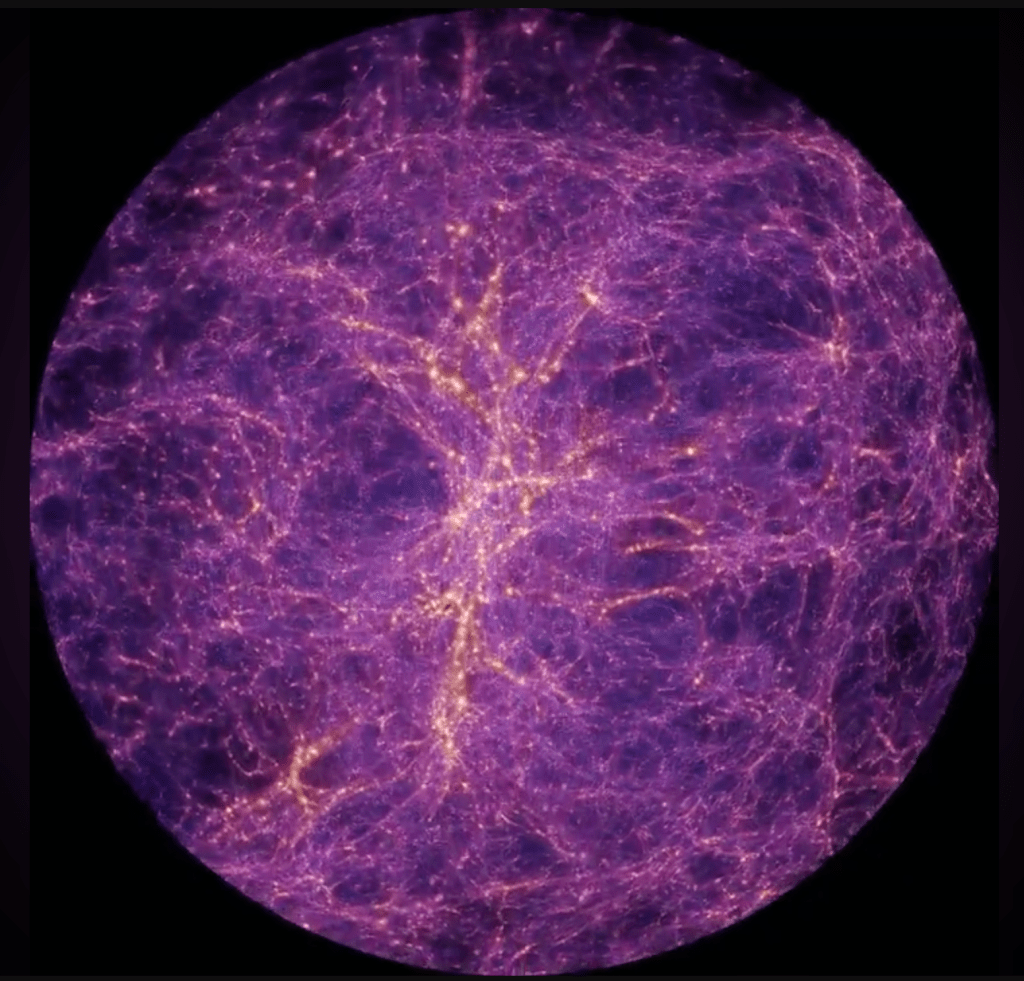
In looking for imagery to show this, I have just today found an animated simulation of the strands of the universe, which is nearly precisely what I am talking about.
This simulation of the cosmos by Volker Springel is for a planetarium show named, “Time Travel – From the Big Bang to Mankind.” While this is showing the evolution of the universe, I see this equally as the way the latticework of human consciousness grows and becomes more complex, from birth throughout life.
Human consciousness starts off as a foggy primordial consciousness, and the connections become clearer over time. The latticework grows and we become more fully ourselves as connections are made.
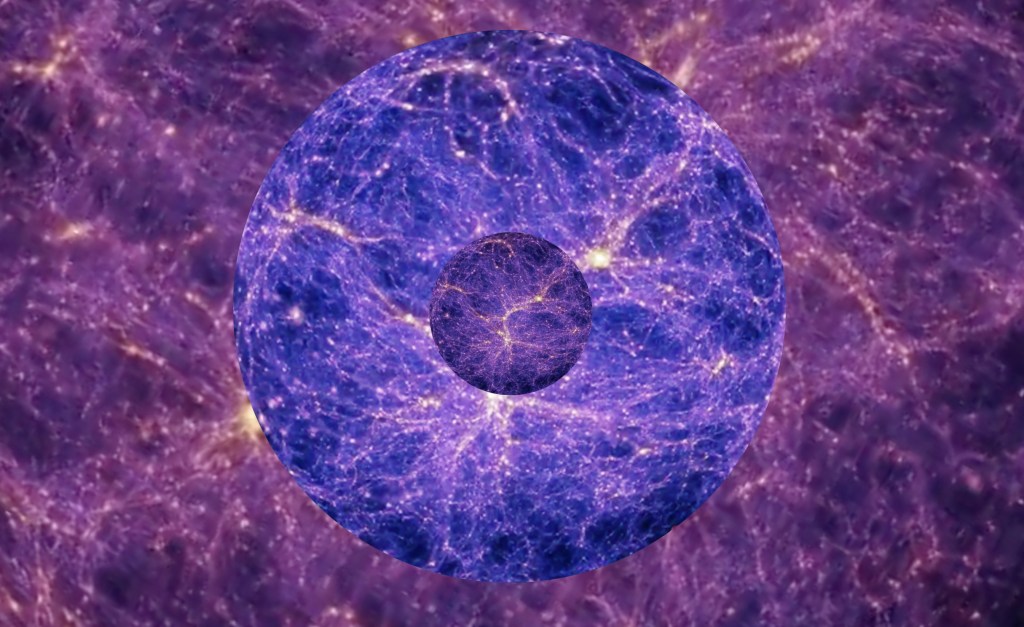
Taking some snapshots of this simulation, I can create a new diagram to replace the cold iceberg on an ocean of water.
What I’m showing here is a sphere within a sphere. This is my new way of describing the mind and consciousness. In its place, the inner sphere of fractal consciousness is our sense of self, or what Freud called the ego, what Jung referred to as the conscious mind.

The outer shell is what Jung referred to as the Personal Unconscious. It is still fractal in nature and is larger than the conscious mind and contains our entire history and the latticework that forms in that time. It informs our awareness of ourselves, even if we are unaware of it much of the time.
Finally, there is the ocean of fractal connections outside the personal unconscious, and that is how I visualize the collective unconscious as described by Jung; it is where we share archetypes, but perhaps it implies a deeper connection to a universal consciousness that we do not yet understand. It means that these primordial images are there, but we don’t understand whether we are all connected to nature, to the universe, or each other in ways that we cannot perceive with the conscious mind.
EXISTENTIAL MATTERS
All this may seem hypothetical and like existential leaps. It may be easy to dismiss these contemplations and visualizations about how the mind and consciousness work, but then we are still left with a life that we have to contend with.
The question we can ask ourselves is whether the current concept we have is helping us or impeding us. Can we meditate or contemplate other ways to see ourselves, so that we can explore not just what it means to be human, but specifically our selves.
HOW DOES THIS HELP ME?
I often talk about meditation, contemplation, and insight journaling to help explore where we are in life and where we are heading. Trying to find a more accurate diagram about how the mind works may seem like an exercise that bears no weight.
On the other hand, having this map may help to meditate on a sense of what fractal strands of our lifetime are vibrating when we feel triggered with something. We may be able to follow a feeling or a thought and find some insight into ourselves so that we can deepen our understanding of our journey in this lifetime. We can follow the strands of our life, and seek the deeper connections and coping mechanisms that affect us daily in these lives.
The more we do these things, the more we can be present for our own journey and for the journey of others around us.
 Follow Your Myth