
BASELINE MOOD & AMPLIFIERS
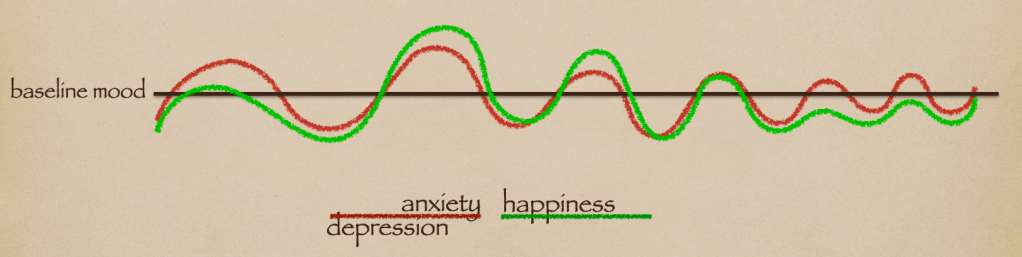
In the past, I’ve written about our baseline mood in life, imagining it as a flat line that represents how we can check in with where we are. This baseline is neutral, neither good nor bad; it is simply a starting point.
As things come in and out of our awareness, our mood shifts. We may feel depressed or simply down as we trend beneath our baseline, and when we feel happy, or even anxious, we may be trending above it, but for different reasons.
When life becomes very stressful, for instance, if we aren’t sleeping or if something stressful is occurring, then we may find ourselves operating consistently above or below our baseline, and from this position, we are less able to meet life’s demands.
HAPPINESS
I hesitate to use happiness on a graph. Happiness is often a fleeting state, lasting moments, days, or months, but rarely experienced as a permanently elevated condition. Some people may describe themselves as generally happy, which may mean they experience a more elevated mood as their baseline, rather than oscillating dramatically around it.

Again, the baseline for each of us is neutral.
If we do little to tend to ourselves, our mood becomes easily amplified either below or above our baseline, in ways that begin to feel outside of our control. When this happens, we become dysregulated, anxious, or depressed, or perhaps a combination of these things.
When something painful or destabilizing happens, we may feel both depressed and anxious at once, pulled downward by despair or grief, while also heightened and vigilant.
These states often activate older neural pathways, experiences of similar down states or anxiety, which may be experienced as a critical or shaming voice that accompanies us.
This doesn’t mean the event itself carries this message, but rather the interpretation and the takeaway is shaped by our earlier experience.
This is in part what I mean in previous articles, when I refer to those clusters of experiences in our unconscious, and the constellations that organize into meaning outside of our conscious awareness.
ANXIETY & NUCLEATION POINTS of the Unconscious
When amplifiers push us above our baseline into anxiety, we may experience hypervigilance, a heightened awareness of potential danger. The amygdala, which is designed to detect threat, goes on alert, releasing cortisol to prepare us for action. This means danger is in our field of awareness.
This, too, is shaped by unconscious complexes, a fractal latticework in our unconscious that began to form early in life.

This fractal latticework looks incredibly complex, but it starts very simply from tiny nucleation points of experience that we are aware of at unconscious levels.
For example, if a baby is left to “cry it out,” the implicit experience may be something like, “no one is coming.” This experience becomes a nucleation point that crystallizes. It may be buried in the unconscious, but it may still be active, even if not remembered with chronological memory. Later, this experience may be reinforced by other moments of unresponsiveness or perceived abandonment.
Over time, this can become internalized into beliefs such as “I’m on my own,” or even “I’m unlovable.”
We can’t interview babies to ask about their experience, but we can try to understand how a baby may internalize a message when reassurance does not come. Over time, this experience may constellate with a later experience, a child gets beaten up on the playground, and no one intervenes. This, too, may reinforce the same constellation with the “no one will come.”
These are just some ways of responding to the signals coming in for a baby or a child, but over time, a constellation of various nucleation points in the unconscious creates a linked sense of experiences. These experiences may begin like a tiny crystal structure, much like a snowflake forming around a nucleation point. Over time, these form relationships, creating meaning through our experiences.
https://www.youtube.com/watch?v=bDPczGUovzE
This crystallizing fractal lattice of our mind steadily informs our sense of Self. With that, we may even hear threads of the narrative we live with evoked from the unconscious. Instead of infusing us with feelings from the unconscious, they may now whisper critical things like, “no one likes you,” or “I’m not good enough,” or whatever these messages are that crystallize deep within. Whether these phrases emerge into our conscious awareness or not, part of the work of therapy is to understand these structures and, with time, to create new fractal structures.
WHAT DOES THIS MEAN?
I’m not looking to assign blame.
For many of us, nothing may have overtly happened. Perhaps, there were small delays, misattunements, or misunderstandings, especially for sensitive children. Perhaps, though we are all sensitive when we are babies, because we are completely vulnerable and rely on others to be there for us, so that we internalize feelings of love and safety.
These internalized experiences become amplifiers in adult life. They shape how we scan for danger, how quickly we feel slighted, and how readily we assign intentions to others.
Without reflection, we may look outward for confirmation of internal voices, rather than stepping back to see the constellation itself, where we can learn to dismantle from this overview position as we take it in.

FIELD OF AWARENESS
As I’m writing about these things, perhaps some experiences come up, or some critical thinking you are aware of. Perhaps it is just a feeling sense that is floating up – an awareness about something you may carry.
These things enter into our field of awareness. To me, the important work is understanding what is coming into our field of awareness, and instead of pushing it away, we give it attention. This does not have to be done by “thinking” about it when in meditation, but rather just being with it. We sink into this field of awareness, and perhaps information is just at the edge of our awareness. We can *feel* that we are in this latticework without knowing exactly what it is.
Feeling into this field of awareness takes time and patience.
This may sound abstract, but consider our body: pain in the knee after running, or discomfort in the back during meditation. These things enter our field of awareness because something needs attention. We may be sitting for an hour in meditation before we realize we are in pain; it slowly comes into our awareness.
In meditation, I invite you to notice the field of psychic awareness in the same way. There are inner signals that want to be known, and they, too, can speak to us.
This is partly what I mean by Insight Meditation, or “folding” with something that arises. We give one thing our attention and become the observing mind.
When we sit with anxiety or depression in this way, we can turn our reflections inward. The goal is to be with whatever is present and to slow ourselves down and find our stillness.
The conscious mind may offer us stories about the world, but meditation invites us to see how these stories affect our internal states, pulling us off our baseline.
In taking one thing at a time, we allow ourselves to begin to rewire neural pathways, and to cultivate a calm abiding approach in our daily life, so that our baseline – if elevated or depressed – can gradually be normalized.
None of this happens in a vacuum, though. We are like explorers plumbing the depths of who we are, and when we come out of meditation, we reflect on what may have been present. We use talk therapy to deepen our awareness, and we continue to fold into these places in our lives as we try to understand the ways we are present in this world.
 Follow Your Myth