I do not claim to be great at meditation, my goal is to help people start with meditation, just as I try to guide them with journaling.
To listen to an audio version of this article, please use the audio file below.
I want to outline the steps here that I will get into in this article though, offering what insight I can as I explore this complex topic. Part of the goal is to offer an accessible starting place for meditation, as I do for journaling in other articles. I see meditation and journaling as connected – for deepening insight. For related articles on journaling go here:
Introduction
Daev’s Meditation Journey thus far
What is Insight Meditation
Learning to Fold
First Fold
Second Fold
Third Fold
1: Attaching Mind to Music
2: Breath
3: Posture
4: Monkey Mind
5: Detachment
Conclusion
Daev’s Meditation Journey thus far.
I began meditation when I was 16 years old with limited success. I based my limited understanding of meditation on the few books I could find at the school library, long before there was the internet, digital books, or YouTube videos. It wasn’t easy to quiet the mind for someone with an active monkey mind – and I wasn’t sure what my end goal was. I suppose I was curious and followed that curiosity, but this turned to frustration and skepticism that it was a worthwhile endeavor.
Later in life, I returned to meditation and still felt like the instructions were vague at best. I would be left with the distinct impression that people didn’t know how to explain meditation. I imagined trying to vaguely teach someone to draw – you hold the pencil, look at your subject, and then…. you draw. Is drawing simply that easy? Yes, at some level, anyone can draw, but there are known methods for learning to draw.
So why did meditation escape me? Why did it frustrate me? Perhaps because there is no tangible end product like a drawing or painting. There is nothing that is tangible that marks our progress… and that can be difficult for humans I think, at least it was for me.
Additionally, in meditation, we are trying to describe something that happens in our mind, and this has always been difficult to capture in words and instructions. Yes, focusing on our breath may be the first step to meditation, but it does not answer what the end goal may look like. Is it simply to bring my nervous system out of fight or flight? Is it to relax? Is it to understand our true nature and feel into the connection of our consciousness to something bigger? Perhaps the answer is yes to all of those questions – but how should one begin?
Life got in the way of my meditation practice, and I focused on the arts. After graduating with a Master’s in Fine Art, I focused on living in the moment, or rather working in the moment, and became a textbook workaholic. At some point, my life crashed down around me, and I had to start over. Going into therapy for the first time – turned into studying psychology, and by 2000 I was back in college studying for my MA in psychology. I wanted to understand more, and this was incredibly valuable but at the same time, I was not attending to that connection that can come from meditation.
Eventually, I married and left California behind with my wife, Sheryl, to live in Colorado and raise a family. We wanted to create a more balanced and creative life.
Life was still hard at times as I navigated this world. At various times I attempted again to find direction in therapy, and meditation. I attended Buddhist meditation sessions in Boulder at the Shambhala Center. Later I attended the Buddhist meditations in large groups of people that were done silently.
I struggled with these silent meditations though, and again the vagueness (to me) of the practice. We were not told to use music, sound, or mantras. There was no instruction before we began, just the chime to indicate the beginning and end.
After nearly 90 minutes of quiet meditation, the lesson would come, but by this time I was feeling tired and left feeling that even the lesson felt vague and didn’t register with me. I kept waiting for the instruction on how to meditate better, but the Dharma lesson was not about that.
I began to bring my own AirPods and would listen to meditation music of my own while others meditated in the silence that was punctuated by snores and farts from some of the 50 or so people that showed each week. I was intuitively reaching for things that I knew would work for me and starting to take some ownership of my meditation practice, but I felt like a fraud in a room of people who somehow must certainly know what I didn’t.
I stopped going to meditation again, feeling again, that there is no There, there.
I felt like I was losing momentum in life again and returned to grad school this time to study Jungian and Depth psychology at Pacifica Graduate Institute. I was again getting back to basics, and again – starting over.

What is Insight Meditation?
Pacifica planted the seeds of my return to meditation during the somatic, embodied practices in the program, as well as the introduction to the Meditations of Marcus Aurelius (which is not strictly speaking actual meditation).
My breakthrough came after grad school gradually on my own, when I found specific music and ways of attending to meditation that are more personal and my own. Some of my meditation hinges on understanding how to get into a flow state when I create artwork, and some are related to extraordinary experiences that are more personal that I will not be sharing right now. I tested some of my insights on meditation and tried to wrap my head around honing my own approach that I could maintain, like when I taught myself to draw.
Over time, I have refined my practice and refer to it as Folding Meditation a type of Insight Meditation, along the lines of Vipassana Meditation.
Vipassana meditation, which means Insight or “to see Clearly” — has its origins in the teachings of the Buddha, making it around 2500 years old. The essence of Vipassana meditation is in experiential insight in the act of meditation. Observing bodily sensations, thoughts, and mental states leads to mindfulness, insight (vipassana), understanding impermanence, suffering (dukkha), and non-self (anatta). This is a very brief and incomplete explanation of Vipassana of course.
My stumbling on techniques feels almost accidental, and based on a mixture of ignorance, curiosity, some luck, and a lot of failed attempts at meditating. It is also steeped in my understanding of psychology and the mind, as well as a growing curiosity regarding the nature of consciousness.
The bottom line is that insight is clarity and understanding that comes from within. It is not simply about calming the mind and lowering blood pressure but rather to deeply know oneself. This practice means being able to drop the defenses, which is part of the practice. The Buddhists would say that knowing oneself does not stop with personal insights but rather includes knowing our true Buddha nature – but this will not be the focus of this article, even as I acknowledge that a connection to something bigger IS part of the insight I am speaking of.
Admittedly, I also have setbacks that make me feel like I am again 16 years old staring at a candle flame making no progress. I’d like to offer some of my personal techniques, with the understanding that I am still refining my practice and may likely be refining it for a long time to come.
LEARNING TO FOLD
As I said, the way I refer to my meditation practice is to refer to it as Insight Meditation or a Folding Meditation. I refer to it as Folding for various reasons such as referring to my folded posture. The term also implies a folding of the mind around something. We can think of this as holding something in our mind, much as we may have focused on a candle flame in meditation practice or a mantra. Once we hold it in our mind, we fold our mind around it. In folding with it, it can feel like we fold our mind inward.
Let me see if I can explain a little bit of how I meditate now. To me, this happens in stages as I meditate, and I do this in typically three stages. However, along the way there are other things that are happening that I will talk about in this article, like breathing, relaxation, and receiving thoughts rather than batting them away.
This process will be difficult to explain, and I acknowledge that at the start here.
First Fold:
At first, I fold my mind around something simple, this can be something I am looking at like a seashell or candle flame. It is at this point I am also focusing on stilling my body, clearing my mind, and working to hold the single object in my mind clearly. When I feel my mind relax into this object and soften, then I will close my eyes if I haven’t already, for the second fold:
Second Fold:
This second step is to fold with a thought, which may be along the lines of “trust” like a mantra but allowing the mind to bend around this word and “feel” its meaning. It helps to breathe in the meaning, expanding your lungs as you say the word in your mind “trust” like you are gently filling your lungs with meaning.
This is again about trying to relax the mind, and let something come through, like what happens when we are in a flow state, or in the “zone.” We aren’t trying to “think” about the word “trust” but rather letting the feel of the word trust come up spontaneously from within, we RECEIVE the meaning. In relaxing into that, we can fold with the word rather than repeating a mantra without feeling – we are opening ourselves up as if to an unconscious process and RECEIVING, not thinking.
Third Fold:
This third folding happens slowly, as we deepen our meditation the goal is to drop our defenses and receive more deeply. If the first and second fold gave you some insight, this deepening level is about receiving something around your sense of self. This stage is sometimes easy to get to spontaneously, but in general I find this to be where the gold is.
To get there though means detaching somewhat from our ego defenses which I will speak of more below.
Remember I am giving an outline of the overall goal in my insight meditation. In this third fold I am in a relaxed state and deepening. I am allowing my mind to fold with something that may come up from the unconscious now. At this point I have relaxed past monkey mind, I feel myself soften inward, and then an insight may come. The thing that comes is generally related to something I am working on in my life. I may not have thought of this thing specifically, this is the part that is spontaneous and feels as though it comes from a deep place inside, perhaps a place of wisdom, or a place that is connected to the collective unconscious. I will give an example of how this looked for me later in this article.
Once I have folded with this thing that has come up from within, and received from deep down I generally come out of my meditation. If I have time I may jot some notes if what came up was particularly helpful, and this can become an inflection point for journaling.
The truth is, that I believe in some ways we are always folding in our minds with something. We may be thinking one thing, and processing at a deeper unconscious level – this is sometimes when intuition comes in, or we solve problems spontaneously, or even in our dreams. We receive something from the unconscious mind.
I’ll share now about some of the things that allow this process to happen and what that may look like.
STEP 1: ATTACHING MIND TO MUSIC
Music and sound have always been a deep part of meditation practices, so for your meditation I suggest having one song that loops while you meditate. Part of the reason I loop one piece of music is that the rhythm of the music can help to descend through the levels of folding I described.
The overall goal of music for me is to deepen my meditation. To do this I do something I refer to as attaching my mind to the music.
This again is a feeling function, not something you can think through. While meditating you are focusing on the first thing you fold with, but you allow the music to guide you downward and inward as well.
The right music can feel like it can guide you as if you are riding a wave inward.
In a way, I think of this as collaborating with the music, and the music takes on a living presence in my mind as I meditate. We can RECEIVE something from the music as we allow it to work through us.
Just as we can BREATHE in the meaning of a word and let it fill our lungs. The idea here is that the music can be taken in through the ears and fill us up as well. We can FEEL the meaning through the vibrations.
Some may argue that we cannot attach our mind to music in meditation, but I believe this is an intuitive ancient practice. I think people do this all the time, in the privacy of their homes, in their cars, using their AirPods, or in rock concerts when they are swaying with closed eyes. We become attached to the music, and receiving.
This is again an open state, a flow state of receiving. What I am saying is that I believe there are multiple paths to going inward, and music can play an important part. If music feels too distracting, then the vibrations of certain instruments, such as Tibetan Singing Bowls, gongs, or chimes combined with the sound of nature perhaps can help to guide the journey inward, serving as a focal point just as a candle flame, or mandala serve this function visually.
STEP 2: Breath.
The breath is a powerful anchor, gently guiding our attention back to the present moment whenever the mind begins to wander. By focusing on the natural rhythm of inhaling and exhaling, we cultivate a sense of inner stillness and presence. In meditation, I often pair my breath with simple words—breathing in a word to receive its meaning and breathing out another to release or connect. This practice not only helps to quiet the restless ‘monkey mind’ but also deepens self-awareness and fosters a sense of balance and calm.
As I have indicated, I allow myself to breathe in the meaning and receive, and breathe out a feeling as well.
If nothing else happens in my meditation, this is a good place to stay for the duration of the meditation practice.
Breathe-In is to receive.
Breathe-Out is to connect.
Although this practice highlights both a metaphorical and physical connection to the world, it also points to a deeper awareness of interdependence—central to insight meditation (Vipassana). Through observing the breath, we cultivate mindfulness of the present moment, noticing the constant interplay between ourselves and the world around us. This awareness can lead to insights into impermanence, interconnectedness, and the nature of self, touching on themes that resonate with the understanding of non-separation in Buddhist thought.
STEP 3: POSTURE.
It is important that you find a posture that feels comfortable for you – whether sitting in lotus on a yoga block or sitting on a chair with feet on the ground. The key is to choose a position that supports your practice and encourages consistency. My goal is to make meditation accessible and sustainable, rather than focusing on overcoming physical discomfort. This perspective may diverge from Vipassana meditation, where sitting with pain is seen as an opportunity to cultivate insight into impermanence and equanimity.
However, there is a balance between avoiding pain and becoming too comfortable. I do NOT recommend lying down, as it can easily signal the body and mind to slip into sleep – something that is not the intention of meditation.
Our posture often reflects our intention. Whether sitting in lotus or in a simple seated position, the gentle folding of our body mirrors the inward folding of the mind. In this way, our physical stance can serve as an external expression of our inner journey.
STEP 4: MONKEY MIND.
What else can we do with monkey mind?
Our mind tends to drift when we meditate, and this can be a frustrating thing that we all experience. Even after days of feeling as though I have had deep meditation, a day will come when monkey-mind returns, and I have a hard time going deep or receiving anything useful.
One technique for dealing with monkey-mind is to focus on the breath as I said, and to return to a breath-connected mantra.
Another way to approach monkey-mind, especially when dealing with anxiety or intrusive thoughts, is to see them as opportunities for deeper understanding. When an intrusive thought arises—something that has haunted me for a long time—I recognize it as a thread from a deeper complex within my psyche that is seeking attention.
Instead of brushing the thought away, I can allow it to surface and gently explore what lies beneath it. For example, if the thought “you are being stupid” arises, rather than resisting it, I can breathe and ask: What is this thought really about? What deeper feeling or belief is trying to emerge?
Often, beneath intrusive thoughts, there are deeper emotions—perhaps pain, fear, or an unresolved memory. By breathing with these feelings and allowing them space, we can uncover what they may be offering us.
This approach doesn’t mean accepting the thought as truth, but rather listening to what it reveals from the unconscious mind so that we can release the thought and what it may be expressing from deeper in our unconscious. This doesn’t mean it will happen in one session, it may mean working patiently with cruel voices and intrusive thoughts over time, to disarm them gently until they dissipate into that equanimity that we seek.
STEP 5: DETACHMENT.
When we meditate, it’s important to set an intention to drop our defenses and detach from our ego consciousness. This detachment allows us to see ourselves objectively, much like the “overview effect” experienced by astronauts who gain a profound perspective shift when viewing Earth from space. Similarly, meditation can give us a higher vantage point on our lives and our place in the cosmos.
At the deepest level, detaching from ego consciousness can lead to moments of true insight—observations and understandings that arise spontaneously from within.
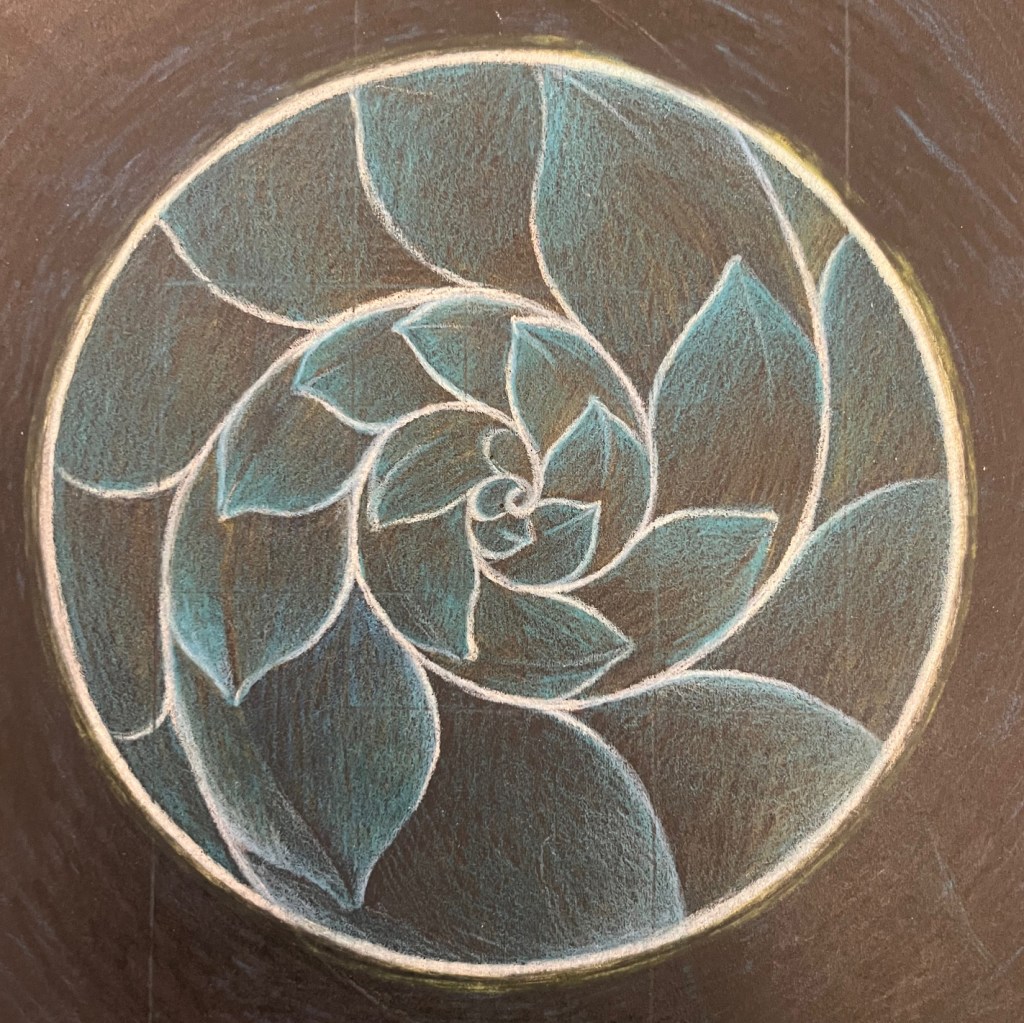
For example, after drawing for some time one evening, I meditated immediately afterward. In my mind, I could see the mandala I had been drawing, and as I deepened into meditation, the drawing appeared, still etched into my conscious mind. Then it began to flicker and fold like a flower – the motion seemed to bring something with it up from my unconscious by itself. I breathed in slowly, opening myself to receive.
This was not monkey-mind thinking about something, it felt as though something was drifting up from a deeper place in the unconscious. Something I had done that day that was defensive of me – came into my awareness.
This awareness continued to unfold in my mind gently, without judgment.
I folded with this understanding and breathed with it, observing my ego-consciousness attachment to something I had been peripherally aware of. I realized this small thing, was connected to a larger narrative thread of my personal story.
Carl Jung described these recurring themes as complexes – charged clusters of related thoughts, emotions, and memories around a core theme that can influence our behavior.
Through detachment in meditation, we can gain insights that may seem small but are part of a larger journey of self-awareness and transformation.
Conclusion: The Ongoing Journey of Folding the Mind.
Meditation, like any meaningful practice, is not about achieving a final destination but about engaging in an ongoing journey of self-discovery and perhaps inner peace. Through it, we may understand more of the nature of our mind, and our connection to the universe at large. Through this process — we may put down some of the things we carry in this lifetime as we gain the insight we seek. We can turn to journaling about what we may receive to amplify those insights and fold consciously, building on what we learn.
As we practice folding the mind through the different stages, from stillness of posture to the deeper layers of detachment, the process reveals insights that are both personal and universal. While the path may not always be clear, and setbacks are inevitable, the very act of sitting with ourselves – through music, breath, or the chaos of monkey-mind – brings us closer to understanding our true nature.
Ultimately, meditation teaches us how to fold with life itself – as we accept the ebb and flow of thoughts, emotions, and experiences, and cultivate a deeper connection to both ourselves and the world around us.
I believe the key is to start, stay curious, and allow the folding and unfolding to happen in its own time. In the end, meditation is one technique, that can be complemented by other things in our lives, like journaling, being in nature, or spending time with family, or friends or any of those things you feel “feed” your soul.
Remember to breathe, receive, trust, and allow yourself to fold inward with intention, and take each session one step at a time as you learn to go inward.
 Follow Your Myth