
Working with clients lately I have felt aware of something being expressed that I have also become aware of in myself. If part of the purpose of psychotherapy is to make conscious something which is unconscious, at least for a Jungian, then I try to listen to the feelings and thoughts that may come up from inside. This may take an active act of conscious effort to gain insight and is what I refer to in shorthand as “folding”, which is a reference to folding one’s mind with something.
I often speak of folding with feelings that come up, and this goes back to the idea of gaining insight by staying with something, which is a subject I have written about previously and can be found in my article: Learning to Fold the Mind, which can be found in this link below:
In this case, the awareness which came up was not of something that I had become aware of internally like an intrusive or critical thought, it wasn’t fleeting.
Instead, I became aware of a lack of something.
There seemed to be something expressed that reminded me of something missing. I can describe it as a flatness, a quiet place, or even a “gap,” but these descriptions are not quite right, because they may imply that nothing is going on.
In the act of folding with something I am simply doing a contemplative or meditative practice, where I am staying with the experience that comes up. This may include a mood that comes in, or being triggered by something that elicits a strong reaction.
I say that I *fold* with it. This folding of the mind inward is a conscious act of observing oneself, and what may be present – or what may be missing as well. So if we can think of a thought or feeling that is temporary as being triggered, that may pass more quickly, what I am getting at is a mood shift that may happen that may be influenced by smaller moments when we are triggered. Let me begin though by talking about those smaller trigger moments before I get into those bigger moods we can get lost within.
AWARENESS OF A TRIGGER.
Understanding what may be present when an emotional state, or thought process happens may be easier to understand.
Let’s say I’m interacting with someone in my life, and they say or do something that bothers me, and I feel triggered. I feel myself react inside, and IF I can be present for the reaction, then I can observe it.
A feeling that may come up that is obvious for instance may be my standard example of having hurt feelings. When we have hurt feelings, or we become angry, we can feel that there is something there. We may become flooded with cortisol when we feel angry. We may become flooded if someone does something to threaten us, even if we are perceiving the threat unconsciously through a change in their tone, or an aggressive look on their face.
Having the awareness that we have been triggered into an emotional response does not mean finding blame, such as, “they made me angry.” This is about trying to become objective in how we observe what comes up. With objectivity, we can understand the feelings, and then begin to drill down into why we may have had this reaction. From here we don’t haul off on the person we think offended us, we are looking to process and find insight. It begins with observing a specific feeling, and then processing to find the insight.
The emotions we may observe in ourselves in these instances may be irritation, agitation, anger, or hurt feelings for instance. What I’m describing may be fleeting emotions, and they could lead to an argument, or moments of irritation, or even resolving something that has not felt particularly good by bringing awareness to it and identifying it.
What I’m talking about is the act of trying to communicate when something triggers us.
DEFENSE MECHANISMS
Alongside being triggered though is a very human reaction of having defenses.
That irritation, anger, or hurt feelings are indicators that something is up for us that may touch into places that feel more vulnerable and harder to identify. This is in part why I discuss with clients the act of meditation and contemplation around things that we observe about ourselves, to bring awareness to what is coming up.
The point of meditating, journaling, or contemplating on things that come up, is that we get to do this in a safe place away from the person or people that triggered us. Now in a safe place, we can look at what happened, and examine the feeling.
Defenses though may be more resilient than just meditating, and sitting with something uncomfortable. This is because they are there to protect us from things that may touch into things that are more painful than the surface-level thing we reacted to.
Something is trying to keep us safe. Now most people may feel like defenses are tedious and irritating, but on the other hand how cool that we have psychic structures within that wish to protect us! Like the stink of a skunk or the quills of a porcupine, we have ways of protecting us from perceived harm, which indicates there are unconscious processes always going on beneath the surface, scanning for danger – and these processes are way ahead of conscious thought.
When it comes to meditating and challenging these defenses, my directive is to go slowly and allow something small to come in. An example I often give people is that if someone has an intrusive or critical thought that comes in when they meditate, the directive from most meditation practices is to observe and let go. Instead, I ask people to allow for something to come up using the practice of insight meditation, and instead to be curious before letting go of that critical voice. What is the voice saying? What is the message it is delivering and why? What is behind that critical voice? Is it telling you something mean? Can we journal afterward and find the nugget of information that may help to banish that critical voice?
Will the nugget inform us the next time we feel triggered so that we can more easily identify the warning signs that we feel under threat when we are triggered by someone or something in the world at large?
I am in no way implying that this type of work is easy to do, and as simple as sitting with something once or twice. This takes time because often our reactions are intertwined with a lifetime of experiences. I say that what we react to is woven into the fabric of our story, our personality if you will.
That is to say that my wish is for people to also be gentle and not fall into criticism that they are notdoing it right. This is part of the critical self-talk I fell into when I began to meditate at 16 years old. I accused myself of not doing it right and even decades later in Boulder, my sense was that others knew how to meditate, and I did not.
WHAT ABOUT BYPASSING EMOTIONS?
I will just make one more point about meditation and contemplation here. There are many ways to meditate, but one thing I am trying to be aware of is meditation AS a way to bypass what is going on within.
The act of meditation in itself may allow us to get past our defenses and see that our mind is bigger than the smaller way we see ourselves. We may gain insights into the nature of the cosmos and our personal self.
On the other hand, I believe part of the value in meditating is to find personal insight, not simply that slow revealing insight into the nature of consciousness, mind, and the Universe which may also lead to personal insight. So my directive about *folding* with something may feel uncomfortable, but it is about sitting with a thought or feeling to gain insight, rather than learning to push it down deeper, or banish it out of consciousness.
Again, if part of the goal for a Jungian is to bring the unconscious into consciousness, then in meditation those things which float up are valuable in gaining access to knowing thyself.
Finally, I also want to acknowledge that what I’m saying here does not mean I don’t think we can access deep and wise places when we meditate, I know that we can. I want to acknowledge that there are many resources on meditation practices, and I also use the meditation app Waking Up by Sam Harris. This app alone offers many resources on learning to meditate.
AWARENESS OF A BIGGER MOOD.
What I’ve described above happens when we *feel* the reaction we are having in a particular moment in time. We may come up not against what someone did or said to us, but up against our own defense mechanisms that we become aware of.
We may have other symptoms, as well. We may feel our face tense, our pulse become more rapid, we may begin to stammer, or our language get more clipped, and louder. These are some of the clues that something is going on.
When something is absent, that is another opportunity to check things out and see what is going on. This may be harder to identify though, because it may feel like we are feeling nothing. We can still check in and see what this more elusive feeling may be.
I am not talking about feeling content or happy though. I’m not talking about being in a place where we let go of things that used to bother us because we’ve been processing things for ages.
I’m talking about feelings that are harder to identify, a flat place perhaps where we may be feeling empty, even unresponsive. In psychology, we use the word anhedonia to describe a lack of feeling pleasure, associated with depression for instance.
This lack of feeling is what I want to take a closer look at in the remainder of this article today. The feelings are not the fleeting spikes of emotion that come up. ‘m speaking of understanding that we have found ourselves in a mood state that is not happy or carefree, but rather it has a quality of feeling disconnected, or like there is a feeling of something missing.
This mood I am speaking of can be compared with being in the doldrums of the sea. This old term which identified a place where ships would become stuck without a wind in their sails, has become something that represents a flat state of mind that we may enter, which I will get into more below.

THE DOLDRUMS
A doldrum is a term that comes from the early 19th century and describes a place along the equator of the planet, where ships would lose their momentum, trapped in windless waters of the ITCZ, the Intertropical Convergence Zone.
For a ship with sails, this occurred, because the trade winds from the northern and southern hemispheres would converge and neutralize one another, creating a band of stillness on the ocean. This would mean a ship would lose all wind and come to a halt, on a sea that was flat. Sailors would describe this as being trapped in the doldrums.
The doldrums have also come to represent that mood, or state of mind that can mean to be in low spirits, having the blues or being down in the dumps. This too may come from the sailors who were stuck in the doldrums, when they were filled with despair at the circumstances, awaiting the next wind to carry their ship forward.
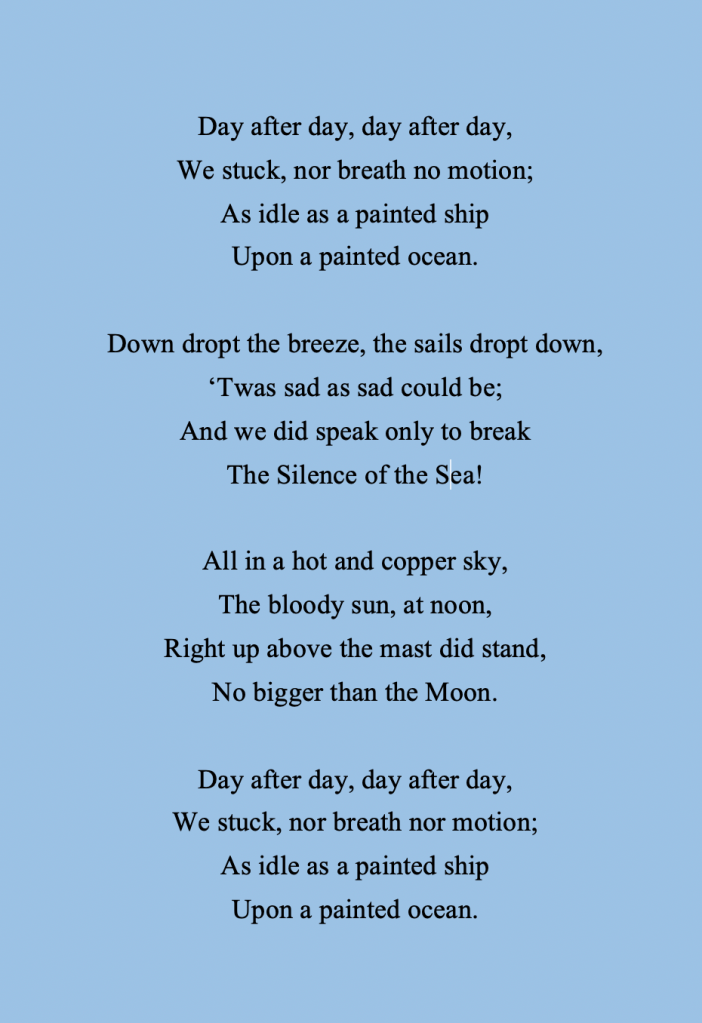
We are in effect each in a ship that glides through the ocean of our lives. At times we can lose the wind in our sails like those sailors of the past. We can look to Coleridge’s poem for the feeling that he paints.
The quote at the beginning of this article is from Samuel Taylor Coleridge’s The Rime of the Ancient Mariner, which I’ll quote some more from here.
INSPIRATION: BREATH OF LIFE.
Coleridge’s poem expresses the feeling of losing the wind in the sails of one’s ship, and the despair that the sailors would experience in the doldrums.
This is a metaphor that speaks to us. We speak of losing the wind in one’s sails and being uninspired and listless. We have stories that explore the opposite of this, what it means to be inspired, and to find one’s muse.
The muse in this case is the opposite, it is the inspiration, the breath of life that propels us forward. Inspiration, the word itself hints at having the wind in our sails propelling us forward on our journey. Inspiration comes from the latin, inspirare: to breathe life into.
To have the wind in one’s sails, to feel it, also speaks to feeling like we have purpose, and direction in life that may feel as though we are being carried along on the breath of life.
This is not to say that we always feel we are in this state. I have written in the past about being in a flow state, and the fragile state of entering in and out of this creative state. The intense flow state that is experienced when we are in a flow state or in the “zone” as we say, may be a part of a bigger vision for our life.
When we are sailing forward, with the wind in our sails, we can feel the wind carrying us forward in our lives. Often though we are unaware of the state of feeling as though we are moving forward until we find the wind has died and the sails have gone slack.
Even then our awareness that we are being carried forward by the winds may have faded, since when the wind fails often our awareness of that wind fades as well.
I have described this experience of losing the wind in our sails in different ways. I have explored losing motivation, purpose, momentum, or being caught in the “gap.”
The various ways of describing this experience allow us to find the right words to describe this feeling but if part of understanding what we are feeling is about processing our personal experience, then I think it’s important to find the words that appeal to oneself. If we can acknowledge that something feels off, or we do not feel ourselves, we can pause and consider what may be coming up.
BENEATH THE SURFACE
In trying to feel beneath the surface of this subject for the last couple weeks I am slowly becoming aware of another element that once again, is the whole point – but even in writing metaphorically about this feeling that can come over us, it is what is missing. That is what is beneath the surface of the water that our ship has stalled on.
The act of contemplation and meditation may help us pause and take notice of when something is missing. As I have spoken in this article, it is not just being aware of something obvious in the room, but trying to be aware of when something is missing, like being in the gap between the trade winds, and our ship coming to a stop. The feeling of not moving, or perhaps having no real direction. This bigger mood, or doldrums that we may find ourselves in may be affecting how we perceive the world in bigger ways that we simply lose awareness of.
The metaphor of the ocean though offers us more to look at. The ocean has always represented the unconscious realms for a depth psychotherapist. It implies hidden realms of things that may be going on in us. It may hold secrets to our past, as well as past generations.
How might we be affected by past generations in our family? What might being uninspired, and feeling like the wind is gone, tell us about our experience?
RETURNING COLOR IN LIFE.
I’m going to end this article with an anecdote from Annaka Harris, an author who writes about neuroscience and philosophy of mind and the nature of consciousness.
In her recent audiobook Lights On, How Understanding Consciousness helps us Understand the Universe, she writes of a woman who has been experiencing debilitating depression and undergoes a brain implant that stimulates part of her brain. A quick disclaimer, please excuse me if I misquote this, as it is only an audible version and I cannot access a digital version of this book to double-check the full account.
In the book, the woman is receiving this brain stimulation, and during the procedure, she asks, “did someone just turn the lights brighter?” No, they hadn’t. Further, she experiences that the color in the room has become more vibrant, more saturated. This experience appears to align with other brain stimulation experiences people have had, where they report enhanced brightness and more vivid color.
Without getting into how this might happen, we may be able to acknowledge that when we are in a mood, or in the doldrums, the way we perceive the world can be affected.
We may literally perceive the world as being flatter, less colorful, less dynamic, less engaging, and yet not be fully aware that this is our experience. The experience may feel that someone has grabbed life’s dimmer switch and turned down the volume, the color, the pleasure, and the wind that is in our sails has been turned down, and find ourselves adrift on the doldrums.
In my own life experience, though I can confirm that I have had that experience of color returning to life, and being conscious of the experience. There was no brain stimulation involved, just the curiosity and work with a therapist that led to me one day pumping gas at a gas station. I remember where I was in Marina Del Rey, when I put the gas nozzle back to rest and looking up I felt color return spontaneously. The sky became vivid blue, the green of the palm trees overhead vivid green. I saw the colors of the cars in traffic going by and experienced everything as more colorful, and even the cacophony of early morning traffic as something pleasurable.
The mood I had been in, the doldrums I found myself adrift in spontaneously lifted in those moments.
This is one anecdote from my own life about how a mood lifted, and I became aware of a physical effect that I had not been aware of up until that point completely. Astounded I went home and wrote about it and have remembered it even 25 years later.
I think we all remember significant things in our lives that affect us and shift our mood, but it is the smaller things that add up to turning down that dimmer switch, and fading the wind from our sails without us noticing. Yet, I also believe that we have some control over those winds internally, by staying with things that are uncomfortable and painful. I believe that with time and intention, we can find our inspiration and bring the wind back so that we can navigate out of the doldrums.
 Follow Your Myth