RECALLING DREAMS
Often, when I talk to people about dreams, people insist they don’t dream. I believe that research has shown that we all dream, and perhaps even that we must dream.
Most people mistake not remembering dreams for meaning they don’t dream. Learning to remember our dreams usually takes some concerted effort. I learned early in my life to give myself pre-sleep suggestions to “remember my dreams,” and then in the morning I learned to wake up and recall the dream, before getting out of bed. Nowadays, I grab my phone when I think I’ve had a significant dream, and jot down a few notes to capture the moment. Other times, I set an alarm if I really want to recall some dreams, and wake around 3:30 am, which I find to be a time that matches my sleep cycles.
In this article, I want to delve a little into dreams, and perhaps how to amplify and pull some meaning out of the dreams that we have. I want to pay attention to settings in dreams, or put another way, the dream stage, because this is where the drama unfolds. Often in dream analysis, we look for archetypal figures who may communicate something in a dream, like the old crone, the wise man, etc.
However, I believe that locations in dreams serve as archetypal liminal places that can be loaded with significance and meaning, as if the place we dream of is expressing something itself.
Although I will explore archetypes in dreams, I will confine this article to archetypal settings in dreams, those inner landscapes and places that we are transported to.
ARCHETYPES
Most people think of archetypes that Carl Jung wrote of, such as the Self, Shadow, Anima/Animus, and the Persona. This, I believe, is a reductive way to think of archetypes, choosing a common symbol that may even be difficult to spot. It could, in other words, be reductive to think that archetypes will simply show up as fairy tales or mythical figures in dreams.
In Archetypes and the Collective Unconscious, Jung wrote;
“There are as many archetypes as there are typical situations in life. Endless repetition has engraved these experiences into our psychic constitution, not in the form of images filled with content, but at first only as forms without content, representing merely the possibility of a certain type of perception and action.”
Jung, above, was alluding to an infinite number of archetypes. To me I often speak about how things are being expressed in life, and although I can’t say that my experience with archetypes feels limitless, I can attest to the feeling that something is being expressed from the unconscious in the language of our mind. The images bubble up, unfolding in our mind weaving a story, a character, a place and time – often instantaneously. The archetypal expression may not be a shadowy figure like Darth Vader, hunting us through a dark castle. It may simply be the dark castle, or perhaps, as we’ll see, a place that is significant to ourselves.
FAIRY TALES & LIMINAL LANDSCAPES
In my own sleep patterns, I have noted that often in the moments I am falling asleep I drift into these liminal archetypal places.
I refer to this as liminal archetypal places, because at times, there is a procession in my mind of imagery that seems to unfold and fold. Sometimes this looks like a mandala of some kind, unfolding from the center. Other times I have witnessed a line shoot in from the right side and intricately draw a mandala-like shape. At other times, I have witnessed the unfolding of a landscape, a meadow with trees, a library that is intricately appointed and full of books. This happens quickly, as though I’ve stepped through a portal into a place which already exists, and I think we’ve all experienced the instantaneous nature of this experience, which makes it even more breathtaking at times.
Let’s remember that stories themselves are expressions of the unconscious and the collective unconscious. We may be driving in our car, and a story unfolds in our mind for some reason. We see the setting and the action. Like a dream unfolding, the story takes shape.
In fairy tales, we often see some of the same symbolic settings take form from the collective unconscious. Some castles rise up in the distance. There may be a stone hut in the woods, or even a gingerbread house. Perhaps there are tunnels, caves, and mansions that unfold in the minds of the fairy tale writers, and forever take root in our culture. Grandma’s house from Red Riding Hood. The kingdom from Little Briar Rose that is overtaken by thorny vines that encircle the city.
LIBRARIES AS SELF?
An archetypal space I return to often in dreams is libraries, which sometimes appear as bookstores. In a recent dream, I no sooner closed my eyes than I felt myself slip into that liminal space. I was stepping forward with my younger son ahead of me, as we ascended a large, ornate circular staircase that may have resembled a double helix.
I knew immediately I was dreaming and was studying the banister of dark wood, which was intricately carved. Looking up, I could see the wall of books at the center of this staircase, and the walls all around were also covered in bookshelves and books. My son branched off to get off on a floor of this library, and I followed him into the darker spaces looking for books together – when I came out of it as suddenly as I went in.
In a dream where we are ascending or descending, perhaps we are moving into the depths of the unconscious, or perhaps ascending to the higher self. In the case of this library, I can amplify this as ascending into my higher self, seeking self-knowledge. The spiral staircase, which may have resembled a DNA helix, may imply the connection to epigenetic memory, or the things that have been handed down from other generations in my family. This doesn’t imply that the memory is recorded in DNA, but rather as a metaphor for something that is handed down.
In terms of psychology, this to me, points to the possibility of something like multi-generational trauma. Many things can get handed down through multiple generations, and perhaps in our dreams, we can sense this in some way. My dream, I believe, offers me clues and insights in these symbolic ways. It could be that a line of depression or anxiety, for instance, can be handed down through a family genetically, but also these traits may be handed down through interactions with one generation to another.
AKASHIC RECORD
The idea of the Akashic record is a metaphysical library that contains the history of our lives, our soul journey.
These libraries and bookstores that I often go to in dreams have the essence of the Akashic record about them, but often they take on a different form, depending on what I am going through. The white walls of the library that I descended to on a subway platform in New York recently, in a dream. A tiny roadside store that protruded from other stores like a box. I knew I was in Jerusalem in this dream (where I’ve never been).
In one dream, I simply wrote;
“I went into a library to find some reference, and there was a bearded man in the corner who had done demonstrations. He admonished me. Why had I missed his demo of calligraphy? On the table was information about doing calligraphy with thick and thin lines, but also elaborate flourishes which were more personal and artistic. The calligraphy was all in white ink on black paper like my art journal.”
In this dream above, I was looking for reference for my little black art pad notebook where I draw mandalas, and journal more purposefully about existential things on my mind.
These libraries, bookstores, and halls of records come up over and over for me. They seem to never take the same form, sometimes being elaborate and beautiful, and other times like the subway stop being whitewashed and barren of books.
In the past, I have often said the devil is in the details when it comes to dreams but when amplifying and trying to understand a dream, I may simply ask myself;
“What was I feeling in this dream?”
The feeling sense I received from the dream may be the expression itself from the unconscious. The sense of awe or joy from being in the spiral staircase library, vs descending into the whitewashed subway library.
What feelings and thoughts did these evoke in me? What bubbled up mentally, and emotionally?
If dreams are like myths or fairy tales that spontaneously take form in our minds, then the setting, the stage, is what we are trying to examine here. Although saying something was a house may sound important and like something we can quickly analyze symbolically as a “home” the details of the dream, and the feeling it evokes to us carries useful information that is being imparted.
HOUSES OF THE MIND
In my studies in grad school, I would often write about dreams, and one idea I explored was the idea that there may be an internal landscape in our minds of places we return to. The high school in our dreamscape that we find ourselves at during stressful times when we feel unprepared. The church or temple from our youth, when we may be struggling with more existential themes.
I theorize that we return to familiar places we know from the real world, but also fictional places of our dream mind. I have written about recurring places from my own dreamscapes, a house in the woods with a porch. I have never been able to get into the house, as the doors are all locked, and the sun is going down.
There is a house by the ocean that is under construction, and the stud walls with no drywall are covered with plastic that flaps in the wind of a gray, stormy sky.
Another familiar place is my childhood home, and often in these dreams, the roof is blowing off in a hurricane, and I am struggling to stop the destruction.
The rooftop that is rotten appears to be a recurring symbol in my dreams.
PROCESSING DREAMS
If we remember the dream, and we jot down details this is much of the battle. We need to remember the dream to extract useful information from it after all.
Afterwards we do what we do with everything. When we journal, I’m often asking clients to track, process, integrate, and synthesize information. Some of this information may come over a series of dreams though, because dreams can be persistent.
We track the dream, then we can come back later and process it. When processing we are trying to amplify what we think we are experiencing in the dream. We write from that intellectual side of what we think it means, as well as the emotional side of what it FEELS like it was imparting to us. Sometimes we don’t know what it might be imparting though until we have more than one dream.
Integration comes from returning to the symbols of a dream, or a recurring dream. It may overlap with when we have this dream. Finally, synthesis is about trying to understand the information being expressed in the dream so that at the very least, we can write about it, as though we are trying to articulate it to ourselves, or for someone else.
How might you articulate the information of a seemingly bizarre dream?
SHOULD WE DISMISS DREAMS?
Many people dismiss dreams outright even if they remember them. I want to be clear I am not suggesting that everything that bubbles up from the unconscious is an important dream, but often we sense WHEN it IS an important dream. We roll over after some dreams and think, oh that was truly random. Other times we wake from a dream feeling like we just received important information – or like we keep going back to the dream and thinking about it.
We can dismiss dreams, of course this is always an option. I personally think that our consciousness is far more complex and amazing than what we perceive as our waking conscious state. Perhaps in some ways we have it backwards, that this dream self, and the collective unconscious is the much bigger part of who we perceive ourselves to be in waking life.
Can we allow ourselves to believe this?
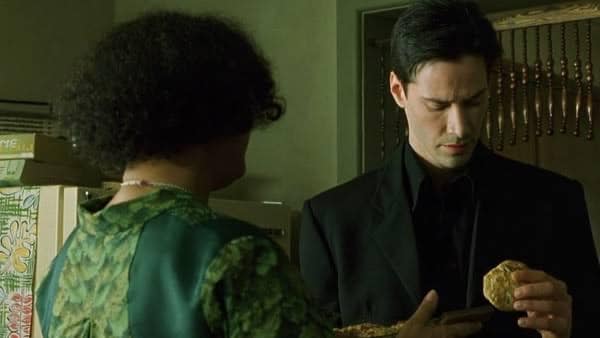
I’m reminded of Neo from the Matrix visiting the Oracle who gives him bad news. She says; “You have a good soul, and I hate giving good people bad news. Oh, don’t worry about it. As soon as you step outside the door, you’ll start feeling better. You’ll remember you don’t believe in any of this fate crap. You’re in control of your own life, remember? Here, take a cookie. I promise by the time you’re done eating it, you’ll feel right as rain.”
You reader may not believe in any of this dream crap. You’re in control of your own life remember? We aren’t controlled by the unconscious or the influence of the collective unconscious. We can’t be.
Maybe have a cookie and write it down, just in case.
 Follow Your Myth