CONTENTS
- Part 1: The Hard Problem of Consciousness.
- Aldous Huxley: Mind at Large
- Mind Revealed in Psychedelics
- A Jungian Approach to Psyche
- Liminal State of Consciousness
- Part 2: Lucid Liminal vs Spectator Liminal
- Liminal Nadir Experience
- Trance States of Consciousness
- Jung’s Framework of Consciousness Flipped
- Insight states
- Conclusion
In recent years, there has been an increasing use of psychedelics both recreationally and as a renewed part of psychedelic therapy sessions. Although I do not offer psychedelic sessions as part of my practice, I have made myself available to guide clients in preparing before sessions, and to help integrate a psychedelic experience afterwards. As part of my continued work in the field of psychotherapy, I’d like to explore this topic today from a Jungian approach to this subject, to try and help synthesize some of what may be happening in a psychedelic therapy session.
There seems to be a crossover in what psychedelics like mushrooms, MDMA, or LSD offer to mental health, which can be helpful across a wide spectrum, from depression to anxiety and PTSD. Some of the most promising work has been done with veterans who often struggle when they transition home after serving in the military, but it is not limited to this subset of human suffering. I will limit most of my discussion to psychedelic mushrooms today (specifically Psilocybe cubensis), an ancient plant medicine that contains the psychoactive ingredients psilocybin and psilocin, as the active chemical catalysts for an inner journey. I will refer to the sessions as journeying, and the participant as the journeyer to distinguish what I’m discussing from casual and recreational use of these plant medicines.
DISCLAIMER
Please note that I am writing as a psychotherapist from the perspective that psychedelics should be treated as sacred medicines and I am not speaking on the subject of recreational use. Additionally, it is important to understand that psychedelics are not suitable for everyone, in particular those who may have dissociative or psychotic disorders in their family history.
THE HARD PROBLEM OF CONSCIOUSNESS
David Chalmers, the Australian philosopher and cognitive scientist best known for his work on the philosophy of consciousness, coined the phrase, “the hard problem of consciousness.” This phrase highlights that even if we understand how much of the brain functions, it still does not explain why or how those processes give rise to a subjective experience – that is, what it feels like to be conscious.
Psychedelics appear to be an important tool that may give us a better understanding of consciousness and the sense of self we have. Often, they do this by providing life-altering experiences that challenge our view of our lives and ourselves very quickly.
The wide range of issues that are helped by psychedelics in therapeutic settings strongly suggests that what we see as mental health issues are related to the very nature of consciousness, and our lack of understanding of what exactly consciousness is. Let’s consider a little what Aldous Huxley thought about the nature of consciousness as a starting point.
In 1954, the English writer and philosopher, Aldous Huxley, used the psychedelic mescaline and wrote The Doors of Perception. In his book, Huxley talks about the “reducing valve to consciousness” and offers that “normal” consciousness reduces how much we are able to perceive in the world. Huxley wrote:

“According to such a theory, each one of us is potentially Mind at Large. But in so far as we are animals, our business is at all costs to survive. To make biological survival possible, Mind at Large has to be funneled through the reducing valve of the brain and the nervous system. What comes out at the other end is a measly trickle of the kind of consciousness which will help us to stay alive on the surface of this particular planet.”
Along these lines, I’m suggesting that this reducing valve may be too narrow at times in our lives when our conscious experience feels restricted, resulting in what we experience as depressive states. Alternatively, the reducing valve may be open too wide for someone who takes in too much and cannot filter out information (or experiences), resulting in a state of heightened anxiety. None of this means that there are no reasons that create these states in ourselves, but rather, as conscious beings, our consciousness oscillates between open and closed states due to a variety of factors. As an example, consider the heightened state of anxiety of someone who may not be able to filter out the world, and we can feel their energy may be described as high-strung or stressed out. We can consider someone at the opposite end, in deep depression, who cannot seem to get out of bed and take in any pleasure in the world; the reducing valve of consciousness may appear narrowly open, or at times even closed altogether.
Aldous Huxley: MIND AT LARGE.
Let’s focus on another phrase by Aldous Huxley. Huxley alluded in his writing to Mind at Large, not simply that we cannot filter out feelings or information that are occurring in our mind (or coming into our awareness), but rather suggesting that consciousness itself may be something that comes through the brain, and is much bigger than the wet brain hypothesis of consciousness that we are all familiar with. In short, a materialist conception of consciousness is that it ALL happens in our brain due to neurons firing, and a delicate chemical balance occurring. Huxley (and many others) are suggesting that this may not be the whole story.
Other ways to describe this Mind at Large are collective consciousness or Universal consciousness. Hindu philosophy speaks of this as well, describing Atman as personal consciousness, and Brahman as Universal consciousness or the absolute, the ultimate reality.
Many scientists and philosophers explore the complex ideas of consciousness or Mind. Examples are Roger Penrose, Stuart Hameroff, Federico Faggin, and Annaka Harris, all of whom might agree that consciousness is not simply occurring in the brain. In 2024, Robert Lawrence Kuhn, philosopher, and host of Closer to Truth published over 200 theories of consciousness in his article, A Landscape of Consciousness: Toward a Taxonomy of Explanations and Implications. Kuhn maintains a stance of skeptical curiosity regarding all theories.
Add to this list the psychiatrist Stanislav Grof, who used psychedelics to treat patients therapeutically before they were reclassified as Schedule 1 drugs and banned from use or research.
Following the law, Grof found other ways to explore the nature of consciousness that are NOT chemically induced, such as using holotropic breathwork a technique he developed to attain altered states of consciousness. Grof moved away from Depth psychology (psychoanalytic school of thought), developing his own school of Transpersonal psychology, theorizing that there is something deeper that Depth psychology was not acknowledging to his satisfaction.
In particular, Grof emphasized the importance of trance states, in which ordinary waking consciousness is suspended. He found that in this state new insight and awareness can spontaneously arise even without psychedelics. These altered states of consciousness observed by Grof and others appear to be where profound expansion of consciousness occurs.
Regardless of the mechanism, Grof and others consistently observed that trance itself is a central feature of transformative experiences, suggesting that this altered state of consciousness is not simply a side effect, but rather a central part of the process.
Let’s look at this through the lens of Jungian and Depth psychology to see if we can consider what may be happening from this framework.
MIND REVEALED IN PSYCHEDELICS.
Much of what we can study in psychology from a Jungian standpoint does not necessarily contradict what the Hindus speak of, or what the psychedelic mystics like Terence McKenna, may also speak of. The word psychedelic comes from the Greek words, psyche (meaning soul or mind) and delos, (meaning manifest). Therefore, psychedelic means mind manifesting. Psychedelic is a term coined by psychiatrist Humphrey Osmond in correspondence to Aldous Huxley, when he wrote:
To fathom Hell or soar angelic,
Just take a pinch of psychedelic.
What experimenters and psychiatrists were finding out in those early days was that there was not just something very promising in psychedelics, but also that there were likely ancient rites that incorporated psychedelics around the globe for healing and wisdom for thousands of years. R. Gordon Wasson, who brought magic mushrooms out of Oaxaca Mexico, introduced this plant medicine to the rest of the world. Wasson would go on to conjecture that psychedelics were also at the heart of the Greek Eleusinian mysteries which he wrote about in his book The Road to Eleusis (1978), and perhaps mushrooms were part of the SOMA, the revered drink from ancient Hindu texts, which Wasson wrote about in SOMA: Divine Mushroom of Immortality (1968).
He and others theorize that psychedelics may have influenced the mind expansion that is at the heart of human culture, influencing many world cultures including the Maya, Egyptians, Greeks, Hindus and Buddhists to name a few.

A JUNGIAN APPROACH TO PSYCHE
In Jungian psychology, we are often taking note of the mind being revealed in daily life, in dream life, in the ways we are triggered in our world, or in our behavior. We look for clues to unconscious processes and think of the conscious mind as only part of the entirety of the Self. Although Freud was speaking of the mind in terms of the Id, ego and superego, Jung was speaking of the mind in a different way that wasn’t pathologizing the unconscious parts of the mind. The conscious mind though is closest to what Freud would describe as the ego mind, what we perceive to be our waking self.
Carl Jung theorized his own explanation of the mind that included three levels, the conscious mind, the personal unconscious, and the collective unconscious. The framework of the mind was revealed to Jung in a dream, much like those who have had altered states of consciousness on psychedelics speak of things being revealed. Jung’s dream which he wrote about in Memories, Dreams, Reflections, helped him to understand the psyche as represented by a house.
In the dream, Jung descended from the upper floor which he perceived as “his house” (representing the conscious mind). He descended to a lower level which was furnished with older dark things from the 15th or 16th centuries (representing the personal unconscious). Deciding to explore further he finds a heavy door and descends into a vaulted basement that seemed, “exceedingly ancient.” Examining the stone floor, he finds one stone slab has a ring and he pulls the stone open. He descends yet again into a cave full of scattered bones and broken pottery. Jung rejected Freud’s interpretation of this dream, and instead set about to analyze it.
He came to understand it as a representation of the mind.
We can see how Jung framed his concept of the mind, and importantly how this information was revealed to him by his own unconscious mind while dreaming. This is perhaps something many of us experience in life. Having studied something or struggled with something, our unconscious mind continues to synthesize the information and presents a solution or understanding that our waking mind failed to see.
In these instances, insight from the unconscious mind appears to bubble up spontaneously.
LIMINAL STATE OF CONSCIOUSNESS
In Jungian psychology, the personal unconscious is understood as a layer of the psyche just beneath conscious awareness, composed of forgotten memories, repressed experiences, unconscious complexes, including the psychic frameworks that shape one’s sense of identity.
I’m suggesting that during a psychedelic session, the first level in the session is what I call a liminal state which occurs as an intermediate level of consciousness—neither fully awake nor fully unconscious—where boundaries dissolve, and material from both the personal and collective unconscious can surface in symbolic, often archetypal form.
In altered states of consciousness, particularly those catalyzed by psychedelic medicines, many describe experiences that reflect this overlap, where personal memories, dreams, or biographical experiences unfold in ways that are intertwined with mythic, symbolic, or archetypal content.
In a recent article on dreams, I wrote about archetypal places that we may go to in dreams and the significance of such places.
https://followyourmyth.com/2025/07/12/dream-archetypes-the-dream-stage/
In this liminal personal unconscious territory that one goes into in a psychedelic session, there may exist archetypal creatures, places and symbols that appear from the unconscious, which the participant may not even be aware are part of their psyche.
In this experience, the archetypal imagery may take on geometric shapes or even sacred forms like sacred mandala geometry that is continually moving and fragmenting into complex fractal patterns. We can be dismissive of fractal patterns as simply hallucinations, but perhaps another term to elucidate what they are – is arrived at by swapping the word archetype for an older term Jung used, “primordial images.” The fractal imagery does in fact seem to be a universal experience that may cross cultures around the world and may have influenced ancient culture for thousands of years.

The fractal patterns may also be part of a much deeper level of consciousness that overlaps in this space where the “doors of perception” have been opened wide.
As theorists such as Stanislav Grof, R. Gordon Wasson, or Aldous Huxley have suggested, these fractal elements may harken to deeper unconscious layers that percolate up to this Liminal level. The artist Alex Grey has spent a career trying to capture the undulating often symmetrical imagery he experiences in these altered states.
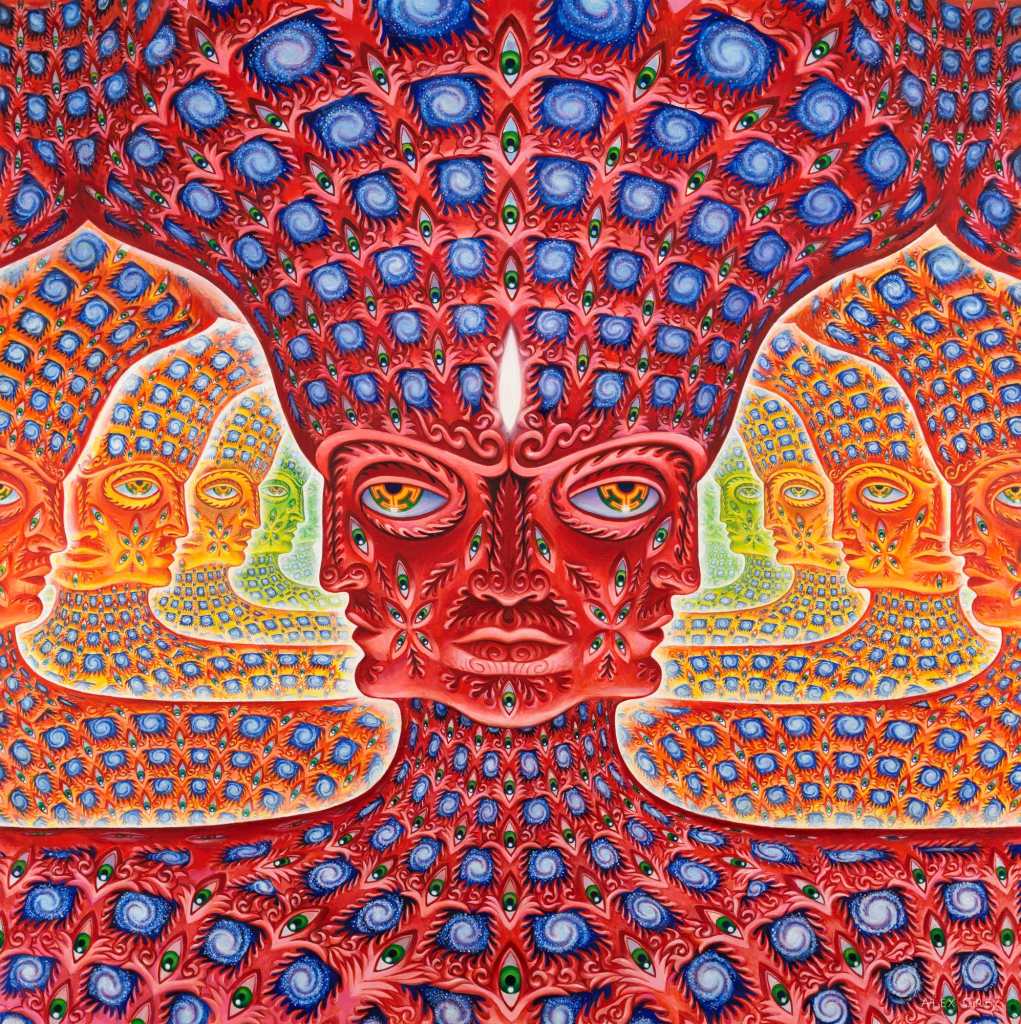
These fractally fragmented beings, portrayed by Alex Grey, harken to deeper unconscious layers that percolate up to this Liminal level. This may correspond to lucid dream states when we witness elements of dreams and snippets of dialogue spontaneously erupting from the unconscious, or even deeper elements from the collective unconscious, where all symbols can rise up from that deep reservoir of human collective memories and experiences that date back millennia.
In this liminal state, the journeyer may experience not just a visual experience of something more expansive than their ego self, but also experience comprehension and clarity at intellectual and emotional levels. I’m suggesting that the receptive state one attains involves what we now understand to be broad integrative brain activity across multiple regions, a kind of temporary orchestration of the whole brain. Research shows there is a suspension of the DMN, the default mode network, which is often associated with our everyday sense of ego or selfhood. With this network quieted, novel patterns of connectivity emerge, allowing information to be synthesized rapidly in new ways, often related to the very areas one is struggling with.
When the journeyer is in this receptive state with the pause of the DMN, this means that the typical ways we react, those internal complexes as described by Jung, are suspended. They are not necessarily suspended in a way that they are invisible, but rather the patterns of thinking are “revealed,” thus mind manifest. We make new connections to how our defenses and complexes work together and result in the typical behavior and emotional patterns that are not serving us.
The end result is that in this Liminal state where ego consciousness is suspended the journeyer who is properly supported with intention may find insight into themselves, and create new neural pathways to support this understanding, thus creating a shift. When the psychedelics leave the system it is then up to the journeyer to integrate this information and work to understand.
A brief caution here: when I say that a properly supported journey can lead to insight, I don’t mean that every psychedelic experience guarantees truth. Browsing online communities—particularly around psychedelics or simulation theory—one might get the impression that these substances reveal a hidden “simulation” or ultimate reality.

But the work I’m describing involves intentional, well-supported sessions that do not feed paranoia or conspiracy thinking. These tools are powerful, but they can be misused—amplifying fear, anxiety, narcissism, and supporting delusional or magical thinking, or even triggering psychosis.
This caution doesn’t negate the possibility of profound or even life-changing experiences. It simply acknowledges that not all interpretations are grounded—and that the container around the experience (intention, preparation, and integration) deeply affects whether the insights are healing or destabilizing.
In my next article I will continue my exploration of these altered states of consciousness and explore the transition from Liminal states of consciousness to Trance states where journeyers report the most profound experiences.
 Follow Your Myth